



Best RC Planes for Beginners and Kids (2026): Ready-to-Fly Trainers


The best first RC plane for most beginners is the HobbyZone XCub 450mm, a ready-to-fly (RTF) trainer with SAFE stabilization, everything in the box, and no FAA registration needed (it is under 250 grams). Its warbird twin, the HobbyZone P-51D Mustang 450mm, shares the same system. Club-field learners should step up to the E-flite Apprentice STS 1.5m; helicopter fans want the Blade 120 S2.
Every pick is in the Pilot Mall radio control collection. Specs come from the manufacturer's product pages and manuals as of October 2026; the evaluations are spec-informed judgment, not flight tests.
Quick Picks
- Best first plane: HobbyZone XCub 450mm, with everything in the box
- Best for warbird fans: HobbyZone P-51D Mustang 450mm, the same SAFE system
- Best for a club field: E-flite Apprentice STS 1.5m, a big, wind-tolerant trainer
- Best helicopter: Blade 120 S2, a true single-rotor trainer
Find their first airplane
Ready-to-fly trainers, warbirds, and helicopters from HobbyZone, E-flite, and Blade.
Shop Radio Control
What is the easiest RC plane to fly?
A high-wing ready-to-fly trainer with SAFE stabilization, like the HobbyZone XCub 450mm, is the easiest because Beginner mode limits pitch and bank and levels the wings when you let go of the sticks.
SAFE (Sensor Assisted Flight Envelope) is Horizon Hobby's stabilization for its HobbyZone, E-flite, and Blade trainers, built to help prevent overcontrol and loss of orientation. A transmitter switch sets the help:
- Beginner: limited pitch and bank, self-leveling when you center the sticks, assisted takeoffs and landings, and throttle-controlled climb and descent.
- Intermediate: more freedom. Self-leveling is slower on the 450mm planes and off on the Apprentice STS, which reverts to Beginner below 100 feet.
- Experienced: no limits, for loops, rolls, and inverted flight.
- Panic Recovery: on the Apprentice STS, Apprentice S 2, and Carbon Cub S 2, press the panic button and release the sticks, and the airplane pulls out of a dive and rolls wings level. On the 450mm planes, flipping back to Beginner does the job.
The manuals' caution: SAFE is flight assistance, not an autopilot, and a recovery needs altitude and a clear path.
How to choose a first RC plane
High-wing trainer or warbird
High-wing trainers (XCub, Apprentice, Carbon Cub) are the classic first-airplane layout; E-flite calls the Apprentice inherently stable. A low-wing warbird is traditionally a second airplane, but the 450mm Mustang carries the same SAFE system and Skill Level 1 rating as the XCub. My rule: buy the one they will want to fly every weekend.
Park size or field size
The 450mm planes suit large yards, parks, and sports fields in light wind, away from crowds. The 1.2 to 1.5 meter trainers want a big open field or an RC club field, and repay you with visibility and wind tolerance. The Blade and UMX can fly in a gym.
Batteries and flight time
All run on lithium polymer (LiPo) packs. The 450mm planes include a USB charger and two single-cell (1S) 400mAh packs, each good for 6 to 8 minutes per the manual. Larger trainers use three-cell (3S) packs, and RTF Basic models include no battery or charger. The manuals say never charge unattended or overnight, and never let minors charge.
What is the best RC plane for beginners?
The HobbyZone XCub 450mm is the best first RC plane for most beginners, the P-51D Mustang 450mm is the warbird alternative, and the Apprentice STS 1.5m suits club-field learners.
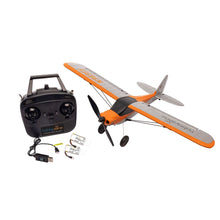
HobbyZone XCub 450mm RTF: best first plane
This scale CubCrafters XCub, a modern descendant of the J-3 Cub, is made of durable EPP foam and rated Skill Level 1: no experience required. The box holds a 5-channel 2.4GHz transmitter, two 1S 400mAh LiPos, a USB charger, AA batteries, and a spare propeller for the pop-off prop saver. Take off on the gear and steerable tailwheel, or remove it and hand launch. An Aerobatics button flies automatic loops and rolls.

HobbyZone
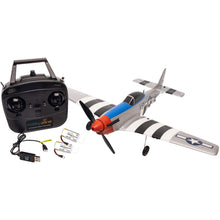
HobbyZone P-51D Mustang 450mm RTF: best for warbird fans
It shares the XCub's 450mm wingspan, electronics, box contents, SAFE modes, Aerobatics button, Skill Level 1 rating, and under-250-gram weight, in a red, white, and blue P-51D scheme with the tailwheel in the scale location. For a kid who loves warbirds, this is the one they will keep flying.

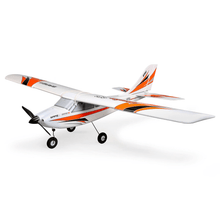
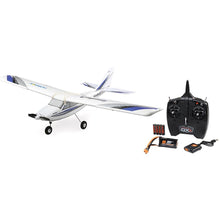
E-flite Apprentice STS 1.5m RTF Basic: best for a club field
The Apprentice STS is the official trainer of the Academy of Model Aeronautics. Its 1.5 meter (59-inch) wingspan is easier to see and handles more wind, and it adds brushless power, tricycle gear, Panic Recovery, and upgrades to SAFE Plus GPS (AutoLand, Virtual Fence, Holding Pattern) and a Landing Assist Sensor. The Spektrum DXS transmitter is included; add a 3S 3200 to 4000mAh LiPo (IC3 or EC3) and a charger.

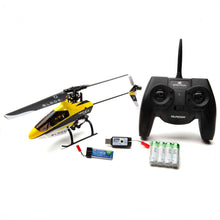
Blade 120 S2 RTF: best first helicopter
Unlike a toy coaxial, the 120 S2 is a true single-rotor, fixed-pitch, flybarless helicopter (330mm main rotor), so the skills carry over to bigger helis. All three SAFE modes self-level when you release the cyclic stick. It arrives assembled with a transmitter, 1S 500mAh LiPo, USB charger, and AA batteries, weighs under 250 grams, and flies about 5 to 6 minutes per pack. Learn to hover in calm air (3 mph or less) or a large gym.

E-Flite
HobbyZone Apprentice S 2 1.2m RTF
This scaled-down Apprentice is sized for large parks and has SAFE, Panic Recovery, tricycle gear, and optional floats. The RTF box includes the transmitter, a 3S Smart LiPo, and a USB-C charger; bring a USB-C power adapter.

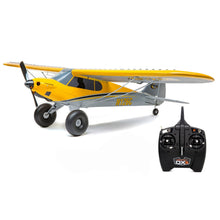
HobbyZone Carbon Cub S 2 1.3m RTF Basic
This scale CubCrafters Carbon Cub rolls on tundra tires for grass, gravel, and pavement, with Panic Recovery and a 400-foot altitude cap in Beginner and Intermediate. As an RTF Basic, it needs a 3S LiPo (IC3 connector) and a charger.

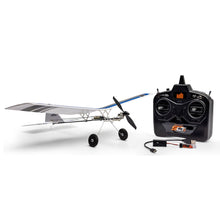
E-flite UMX Slow Ultra Stick RTF
This 46-gram (with battery) slow flyer suits gyms and calm days, with AS3X stabilization and switchable SAFE Select. E-flite rates it Skill Level 2, a next step after a trainer, so make it the indoor second plane.

Compare the options
| Model | Type and size | In the box | Needs registration | Best for |
|---|---|---|---|---|
| XCub 450mm | High-wing trainer, 450mm | Everything, two batteries | No (under 250 g) | First plane |
| P-51D Mustang 450mm | WWII warbird, 450mm | Everything, two batteries | No (under 250 g) | Warbird fans |
| Apprentice STS 1.5m | High-wing trainer, 1.5 m | Add 3S battery and charger | Yes | Club field, instructor |
| Blade 120 S2 | Helicopter, 330mm rotor | Everything | No (under 250 g) | First helicopter |
| Apprentice S 2 1.2m | High-wing trainer, 1.2 m | Transmitter, battery, USB-C charger | Yes | Large parks |
| Carbon Cub S 2 1.3m | Scale Cub, 1.3 m | Add 3S battery and charger | Yes | Grass and gravel |
| UMX Slow Ultra Stick | Slow flyer, 501mm | Everything | No (46 g) | Indoor second plane |
Is an RC plane a good gift for a kid?
Yes for kids 14 and older, the minimum age in every manual here, and for younger kids only as a shared project with a supervising adult.
Each manual reads "Not for children under 14 years. This is not a toy," and rules out use by children without direct adult supervision. For younger pilots, an adult owns the airplane, charges the batteries, and stands alongside. The Apprentice STS's DXS transmitter also works as a wireless buddy box with a second Spektrum transmitter and an optional remote receiver, so an instructor takes over by releasing a switch.
Who should skip an RC plane?
- Kids under 14 who want to fly alone. The manuals rule that out; see our future aviator gifts or aviation gifts for children instead.
- The aspiring pilot who wants cockpit practice. An RC plane teaches flying from the ground, not radios or instruments; a home flight simulator fits better (see our flight simulator equipment guide).
- A licensed pilot who wants gear for the cockpit. An RC plane is a hobby gift; for things they will use on every flight, start with our best gifts for pilots.
What are the FAA rules for flying an RC plane?
Pass the free TRUST test, register any model weighing 250 grams or more, and fly within sight, at or below 400 feet in uncontrolled airspace.
RC airplanes flown for fun follow the FAA's recreational flyer rules, the same as drones:
- Pass TRUST before you fly. The Recreational UAS Safety Test is free and online through FAA-approved administrators, including the Academy of Model Aeronautics, and every question is correctable to 100 percent. Carry the certificate.
- Register at 250 grams or more. One recreational registration covers all your aircraft for three years; mark the number on each model. Owners under 13 need someone 13 or older to register. Registered models must broadcast Remote ID unless flown within an FAA-Recognized Identification Area (FRIA).
- Fly by the rules. Fly only for fun and within visual line of sight, give way to other aircraft, stay at or below 400 feet in uncontrolled (Class G) airspace, get LAANC or DroneZone authorization in controlled airspace, and follow a recognized community-based organization's safety guidelines. The FAA's B4UFLY app shows where it is safe to fly.
The XCub, P-51D, Blade 120 S2, and UMX are under 250 grams; the Apprentice STS, Apprentice S 2, and Carbon Cub S 2 are over it per their manuals, so register them and ask your club whether its field is a FRIA. More in our guide to FAA drone rules.
Frequently asked questions
What does RTF mean on an RC plane?
RTF stands for ready-to-fly: the airplane comes factory-built with its transmitter and needs little or no assembly. A full RTF such as the XCub, P-51D, or Blade 120 S2 also includes the flight battery and charger. An RTF Basic, like the Apprentice STS or Carbon Cub S 2, does not, so buy a compatible 3S LiPo and charger with it.
What age is an RC plane appropriate for?
Every manual for the models in this guide says not for children under 14, not a toy, and not for children without direct adult supervision, and the small models' manuals say minors should never charge the LiPo batteries. A 14-year-old can realistically learn on a SAFE trainer; a younger child can fly alongside a supervising adult.
Do I need to register an RC plane with the FAA?
Only if it weighs 250 grams (0.55 pounds) or more, but every recreational flyer must pass the free online TRUST test and carry proof. Registration covers all your aircraft for three years, and registered models must broadcast Remote ID unless flown within an FAA-Recognized Identification Area. The XCub, P-51D, Blade 120 S2, and UMX Slow Ultra Stick are under 250 grams.
What does SAFE mean on an RC plane?
SAFE stands for Sensor Assisted Flight Envelope, the stabilization in HobbyZone, E-flite, and Blade trainers. Beginner mode limits pitch and bank and self-levels, Intermediate allows more freedom, and Experienced removes the limits. On models with Panic Recovery, such as the Apprentice STS, pressing the panic button and releasing the sticks rolls the wings level. It assists; it is not an autopilot.
How long does an RC plane fly on one battery?
Expect short flights. The XCub and P-51D 450mm manuals say 6 to 8 minutes per charge, and both include two batteries that each charge in about 60 minutes. The Blade 120 S2 flies about 5 to 6 minutes per pack, and the Apprentice STS manual starts new pilots on a 5-minute timer. Spare batteries mean longer sessions.
About the author: Neil S. Glazer is a commercial pilot with multi-engine and instrument ratings and the founder of PilotMall.com. He has spent more than two decades flying, testing, and selling the gear pilots depend on, and every product recommendation on this site is grounded in that firsthand experience. Read more on his author page.