



Pilot Epaulets: What the Stripes Mean and How to Wear Them


Epaulets are the shoulder insignia worn on uniforms to show rank. On a pilot's uniform they take the form of shoulder boards: fabric boards carrying one to four stripes, worn on the shoulder straps of the shirt or jacket. The word comes from the French epaulette, a diminutive of epaule, meaning shoulder, so an epaulet is literally a little shoulder. The stripe count is the whole message: at most airlines, four stripes identify the captain and three the first officer.
Quick answer: the common airline ladder is 4 stripes for a captain, 3 for a first officer or senior first officer, 2 for a second officer or flight engineer, and 1 for a pilot in training. There is no worldwide standard. Each operator sets its own ladder in its uniform manual, so wear exactly what your company issues.
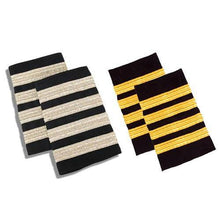
Need a set? Pilot Mall's Premium Epaulets shoulder boards come in 1 through 4 bar versions, gold or silver on black or blue fabric. Click for Price.
What pilot epaulet stripes mean
The most common airline convention runs four bars down to one:
| Stripes | Typical rank | What it signals |
|---|---|---|
| 4 | Captain | Command of the aircraft |
| 3 | First officer (senior first officer at some carriers) | Second in command |
| 2 | Second officer or flight engineer | Third crewmember grades where they exist |
| 1 | Pilot in training or cadet | Trainee status at airlines and academies |
Two caveats keep you out of trouble. First, there is no worldwide standardization: airlines issue different stripe counts for the same job title depending on the operator and on experience level, so the table above is a convention, not a rule. Second, rank shows in two places on a full airline uniform: soft epaulets on the shirt shoulders and matching braid rings on the blazer sleeves.
Training operators borrow the same system and remap it. One large flight academy starts new students with no epaulets at all, issues bar-free black boards at the private certificate, one bar for the instrument rating, two for the commercial certificate, three for flight instructors, and four for standardization staff. Your school's ladder may differ. The point is that at a school the bars mark progress through your ratings, not a crew position.
A short history: from musket belts to the flight deck
Epaulets began in late 17th century France as bunches of ribbon on the shoulders of military coats, and they were partly functional: the ribbons kept shoulder belts from slipping. Through the 18th century they hardened into formal rank insignia across European armies, with officers wearing silver or gold. The British Royal Navy formally adopted epaulettes (the British spelling) in 1795, the U.S. Navy authorized them in 1797, and the U.S. Army specified them for officers in 1832, silver for infantry and gold for artillery and other branches.
The ornate fringed versions faded from working dress during the 1800s. The British Army abolished the large gold-fringed pattern for officers in 1855, and by the early 20th century fringed epaulettes survived mainly on ceremonial uniforms.
Airlines inherited the look from the sea. Before the 1930s, airline pilots flew in WWI-derived kit: leather jackets, scarves, and soft leather helmets. Then Pan American World Airways dressed its flying boat crews almost identically to naval officers, down to the white hat, double-breasted dark jacket, and gold sleeve braid indicating rank. Pan Am was selling its Clippers against ocean liners and wanted captains who read as ship captains. Every major carrier eventually adopted its own version, and the white shirt, dark jacket, and rank stripes remain the industry standard today.
Types of pilot epaulets: soft boards vs hard boards
Hard shoulder boards are the stiffened, simplified descendants of the military epaulette: no fringe, and the board does not extend beyond the shoulder seam. They belong to formal jackets and outerwear.
Soft boards, formally called shoulder marks, are what working pilots actually wear: a flat cloth tube that slides over the shirt's shoulder strap and carries embroidered or pinned-on stripes. The tube design exists so insignia can be swapped in seconds when a pilot upgrades. Airline versions are flattened cloth tubes with cloth or bullion braid stripes; modern sets like Pilot Mall's use polished metal bars on black or blue fabric.
Slider vs button attachment
Sliders are the cloth-tube type above: they slip over the shoulder strap and stay put without hardware. Button-attached boards use the older military method: the board rides a small strap parallel to the shoulder seam, called a passant, and fastens through a button near the collar. Historic coats even laced epaulettes through holes in the shoulder. For a standard pilot shirt, sliders are the answer, because the shirt's strap and collar button are made for them.
How to wear pilot epaulets correctly
- Location: the board wears on the shoulder strap, also called the epaulet loop, found on a standard pilot shirt or jacket, and it sits flat on top of the shoulder.
- Orientation: the bars face forward, on both shoulders.
- Count: wear the stripe count your operator assigned you, no more. The company uniform manual is the final authority at any airline or school.
- With the blazer: on a full airline uniform the jacket usually shows rank as sleeve braid rings, while the shirt carries the shoulder boards. The two should agree.
Buying epaulets that last
A working pilot slides epaulets on and off hundreds of times a year, so buy boards that hold their shape and stripes that stay bright. Pilot Mall's Premium Epaulets: Traditional Shoulder Boards for Aviators come in 1, 2, 3, or 4 bar versions with polished gold or silver bars on black or blue fabric, which covers the uniform spec at most operators. Click for Price.
They need the right shirt under them. Lift Aviation's Flextech professional pilot shirts have the shoulder straps the boards slide onto, in long sleeve and short sleeve eyelet versions (Click for Price on each product page). One detail that trips up new buyers: the reinforced eyelets are sized for wing pins and badges, not for the epaulets. The boards ride the shoulder strap, and they are sold separately from the shirt.
Look the part from day one
Traditional shoulder boards, Lift Aviation Flextech shirts, and the rest of the professional kit.
Shop Professional Pilot Shirts →Frequently asked questions
What do three stripes on pilot epaulets mean?
At most airlines, three stripes identify a first officer, the second in command. Some carriers split the grade and issue three stripes to a senior first officer, so the exact meaning depends on the operator's own uniform standard.
What is the difference between captain and first officer epaulets?
The stripe count. A captain wears four stripes and a first officer wears three at most airlines. On a full uniform the same rank repeats as braid rings on the blazer sleeves, so the shoulders and the sleeves should always agree.
Do student pilots wear epaulets?
Often, yes. No federal rule requires or forbids them; dress standards are employer policy. Many flight schools issue airline-style uniforms and use a bar-free board or a single stripe for new students, then add stripes as the student earns certificates and ratings.
How do you attach epaulets to a pilot shirt?
Soft shoulder boards slide over the shoulder strap, sometimes called the epaulet loop, sewn into a standard pilot shirt, with the bars facing forward. Button-style boards fasten through a button near the collar. On eyelet-equipped pilot shirts, the eyelets are for wing pins, not epaulets.