




Watch Your Attitude: A Complete Guide to Aircraft Attitude Indicators
During flight, VFR pilots can simply look outside the cockpit at the wings and the aircraft’s cowling’s relationship to the horizon, then use that visual as their unofficial “attitude indicator.” For IFR pilots flying on instruments, however, the AI is critically important.
But don’t tune out yet, VFR pilots. Keep reading for a refresher on what the AI gauge is, how it works, how to read it, and potential instrument errors to watch out for.
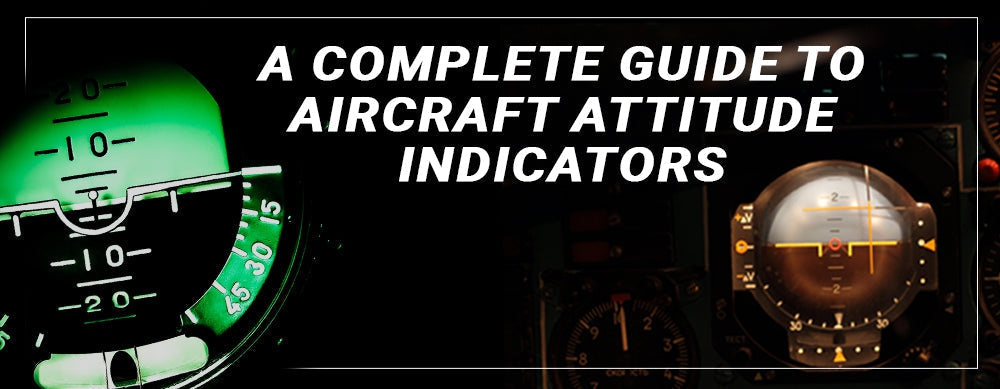


How's your attitude? No, we're not talking about your pilot mindset, though that is important too. Today we are continuing our aircraft instrumentation series with a deep dive on the attitude indicator, or "AI" for short.
During flight, VFR pilots can simply look outside the cockpit at the wings and the cowling's relationship to the horizon and use that visual as their unofficial attitude indicator. For IFR pilots flying on instruments, the AI is critically important. But don't tune out yet, VFR pilots. There is always a chance you could one day fly into rapidly developing instrument meteorological conditions (IMC), and in that circumstance you would need to know the basics of how to use your instruments to maintain control of the aircraft and fly back to clear weather.
Instrument flying experience is also important at night, when night flying illusions can easily cause disorientation. Many times the horizon is not even visible, just a solid haze between the sky and the ground. If you're comfortable using your instruments, you'll be able to cross-check what you think you see or feel.
This guide covers what the AI gauge is, how it works, how to read it, the instrument errors to watch for, and, if your panel still runs on a vacuum pump, whether a vacuum, electric, or digital attitude indicator should be your next upgrade.

Key Takeaways
- The attitude indicator (also called the artificial horizon or gyro horizon) displays pitch and bank against an artificial horizon, making it the only instrument that shows both axes at a single glance.
- Traditional AIs use a gyroscope spun by the vacuum system or the electrical system; glass cockpits replace the gyro entirely with a solid-state AHRS.
- Read bank from the pointer against the 10, 20, 30, 45, and 60 degree marks, and read pitch from the 5 and 10 degree horizon lines behind the miniature aircraft.
- Vacuum pump failures are insidious: the gyro spools down slowly and the display leans into a believable false bank, so cross-check your suction gauge and know your partial-panel scan.
- If your vacuum AI is due for overhaul, a digital replacement like the uAvionix AV-30 eliminates tumble limits, precession drift, and the vacuum system itself.

What Is an Attitude Indicator?
The attitude indicator is a direct indicating gyroscopic flight instrument mounted near the center of the instrument panel. It displays both pitch and bank against an artificial horizon display.
Also referred to as an artificial horizon or gyro horizon, the AI monitors your aircraft's orientation relative to the Earth's horizon. When used along with the heading indicator and turn indicator, the attitude indicator helps pilots maintain straight and level flight as well as execute coordinated turns, maintaining bank control throughout.
There are several types of AIs: the traditional vacuum-driven attitude indicator, the electric attitude indicator, and the digital (solid-state) attitude indicator found in glass panels and modern retrofit instruments. We compare all three in the upgrade section below.

How Does an Attitude Indicator Work?
The gyroscope inside
Attitude indicators are also called gyro horizons or attitude gyros because they use a built-in gyroscope as the source of their readings. The AI's gyroscope is usually powered using suction from an onboard vacuum pump, although in some planes it operates on direct current from the electrical system instead.
The AI gyro is gimbaled with a vertical spin axis. The indicator's gimbal rings spin freely on the lateral and longitudinal axes so the instrument can give both pitch attitude and roll attitude data. As a direct indicating instrument, the AI shows bank and pitch attitude changes in real time with no lag.
Glass cockpits: AHRS instead of a gyro
In a glass cockpit with a primary flight display, there is no physical gyroscope behind the attitude picture. A solid-state attitude source gets its data from the Attitude and Heading Reference System (AHRS), and in larger aircraft from an Inertial Reference Unit (IRU) or Inertial Navigation System (INS). The display looks the same, but the failure modes and limitations are completely different, which matters when we talk upgrades later.
After reading the rest of this article, watch Aviation Theory's attitude indicator video to see examples of the different attitude indicator designs, get tips on how to read sky pointers (the sometimes-confusing glass cockpit versions of analog attitude indicators), and see an easy-to-follow visual of how gyroscopic precession works.

How to Read an Attitude Indicator
The AI gives you a quick snapshot of both your pitch and bank attitudes in a single glance. Its gauge contains a pictorial representation of an aircraft, the sky, the land, and an artificial horizon line. As you dip your wings into a banking turn, or bring your aircraft's nose up or down, the position of the miniature aircraft on the gauge face will mirror your actions. Hash marks, pointers, arrows, and lines on the face help quantify the degree of change.
How to read the bank indicator
The little aircraft icon is good for a quick visual check of your bank information. Your bank indicator shows your bank angle, or the angle between the horizon and your plane's lateral axis.
As you enter a bank, the miniature aircraft on your attitude indicator gauge will roll left or right with you. For more precise bank degree readings, look at the curved banking degree scale along the top of the gauge face and check the position of the bank pointer against the fixed scale hash marks.
Most gauges have large hashes for 30 and 60 degree bank angles along with a dot-shaped indicator for 45 degree banks. Thinner hash marks at 10 and 20 degrees serve as visual interpolation aids for bank angles under 30 degrees.
Pro Tip: Don't confuse the turn coordinator with the bank indicator. Your turn coordinator indicates if and at what speed your aircraft is turning. The bank indicator simply measures the angle between your wings and the horizon.

How to read the pitch indicator
The pitch indicator portion of your AI measures the angle between the horizon and the longitudinal axis of your aircraft. In simple terms, it measures how much your aircraft's nose is angling up or down relative to the horizon.
As the gyroscope registers a change in pitch, the miniature aircraft on your gauge will move vertically up or down relative to the artificial horizon. Watch the position of the little dot between the wings of the mini plane. This marks your current pitch angle. Pitch angles are communicated using horizontal lines in 5 degree increments both up and down. The 5 degree lines are short and alternate with long, labeled 10 degree lines.
When the wings of the miniature aircraft are lined up with the horizon bar, the aircraft is in straight and level flight. Keep in mind that in a glass cockpit, the AHRS is providing the pitch and roll data for the aircraft attitude.
Pro Tip: The pitch indicator doesn't tell you if your plane is climbing or descending. It only communicates the attitude. You'll need to check your vertical speed indicator (VSI) to know if your altitude is changing and, if so, how quickly.
Common Attitude Indicator Errors
The good news is that attitude indicators have rather limited errors, most of which can be easily corrected.
Attitude adjustment knob misalignment
Some attitude indicators have an adjustment knob that lets you move the miniature aircraft based on your point of view. Be sure you only make such adjustments when you are on the ground or at least flying straight and level in visual meteorological conditions (VMC).
Pitch and bank limits
Older AIs had pitch limits of 60 degrees and bank limits of 100 degrees. Exceeding those limits would cause the gyro to "topple" and need to realign with the horizon. Newer mechanical AIs usually have pitch limits of at least 85 degrees and no bank limits at all, and digital AHRS instruments have no tumble limits whatsoever.
Gyroscopic precession
Since the Earth rotates at about 15 degrees per hour, the attitude indicator's gyro alignment drifts away from the actual horizon over time. For vertical gyros like the attitude indicator, the drift effect is worst at the equator and less severe at the poles.
To offset precession, your indicator should periodically re-align with the horizon. If you notice it has drifted off and not realigned, you can manually align it when at a straight and level attitude or on the ground.
System contamination
In a vacuum powered gyro system, if the instrument's container box fails, contaminants can seep in and air can leak out. Both cause reading errors. A clogged central air filter also starves the gyro of airflow and slows the rotor, producing sluggish, lagging indications well before the instrument fails outright.
Vacuum vs Electric vs Digital: Which AI Belongs in Your Panel?
Sooner or later every owner of a legacy panel faces the same decision: the vacuum attitude indicator starts wandering during run-up, the overhaul quote arrives, and you have to choose whether to repair the old technology or step up to something newer. Here is how the three options actually compare in the airplane.
| Type | Power Source | Typical Failure Mode | Best For |
|---|---|---|---|
| Vacuum gyro | Engine-driven vacuum pump | Slow gyro spool-down after pump failure with a misleading, gradually leaning display | Keeping a stock legacy panel original |
| Electric gyro | Aircraft DC electrical system | Bearing wear over time; a warning flag appears on power loss | Redundancy alongside a vacuum system |
| Digital (AHRS) | Ship's power with internal battery backup | Hard fail with a flagged display, no slow false lean | Panel upgrades and serious IFR flying |
The case for keeping vacuum
Vacuum AIs are simple, field-overhaulable, and independent of your electrical system. If you fly day VFR in a vintage aircraft and want to keep the panel period-correct, an overhauled vacuum AI is a legitimate choice. The trade-off is the failure mode: dry vacuum pumps routinely fail without warning, and the dying gyro lies to you slowly instead of failing obviously. If you stay vacuum, scan the suction gauge religiously and treat any reading outside the green arc as an AI failure in progress.
When an electric AI makes sense
Electric attitude indicators run off the aircraft's DC bus, so they survive a vacuum pump failure completely. Historically they were installed as backup instruments next to a vacuum primary, and that is still where they shine: two dissimilar power sources means no single failure takes away your attitude reference. They are still spinning-mass gyros, though, so bearing wear, spin-up time, and precession all still apply.
Why most upgrades go digital
Solid-state AHRS instruments have no rotor to spool down, no tumble limits, no precession drift, and a built-in backup battery that keeps the display alive through an alternator failure. Retrofit units like the uAvionix AV-30-C drop into the same 3-inch round hole your old gyro occupied and add a modern attitude display plus configurable readouts your vacuum instrument never offered. For type-certificated aircraft the AV-30-C carries the approvals an installer needs, while experimental and homebuilt owners can fit the AV-30-E version without the certified paperwork.
Your upgrade path, step by step
- Renter or student: You fly what's in the panel, so train for the vacuum failure instead. A view-limiting device and regular partial-panel practice are your best investment.
- Owner with a healthy vacuum AI: Add redundancy before you need it. A portable AHRS source that feeds an attitude display to your tablet gives you an independent cross-check for situational awareness.
- Owner facing an AI overhaul: This is the moment to go digital. The overhaul money goes toward a solid-state instrument instead of recycling 1960s technology, and many owners remove the vacuum system entirely once the last gyro is gone. Coordinate with your avionics shop on the approved model list and your aircraft's equipment requirements.
- Experimental builder: Skip the vacuum system from day one and panel-plan around digital instruments. You'll save weight, plumbing, and a known failure point.
Browse the full aviation electronics collection or the dedicated AHRS receivers for iPad lineup to see what fits your mission.
Gear Up: Attitude Indicator Upgrades and IFR Training Picks
These are the picks we point pilots to most often when the conversation turns to attitude instruments and instrument-flying proficiency. Every link goes to live product data.

uAvionix AV-30-C Certified Digital MFD: Retire Your Vacuum Gyro for Good
Certified 3-inch digital multi-function display built to replace legacy round-gauge instruments in type-certificated aircraft.
- Drops into a standard 3-inch instrument cutout, replacing the mechanical AI or DG
- Solid-state AHRS attitude with no tumble limits and no precession drift
- Internal backup battery keeps the display alive through an electrical failure
- Configurable fields add data your old gyro never showed, from G load to bus voltage
- This is a panel-mount instrument, so plan on installation and sign-off by an avionics shop or A&P, not a weekend swap
Perfect for: owners of certified aircraft replacing a worn vacuum attitude indicator with modern solid-state reliability.
Click for Price →
uAvionix AV-30-E Experimental Digital MFD: The Same Display Without the Certified Paperwork
Experimental-category version of the AV-30, designed to replace aging mechanical gauges in homebuilt and experimental aircraft.
- Same 3-inch form factor and solid-state attitude display as the certified unit
- Configurable as attitude indicator or directional gyro
- No vacuum system required, which removes plumbing, weight, and a failure point
Perfect for: experimental builders and owners panel-planning around digital instruments from day one.
Click for Price →
Appareo Stratus 4 Portable ADS-B Receiver: Backup Attitude on Your Tablet
Fourth-generation portable receiver with automatic AHRS that streams attitude for synthetic vision, dual-band ADS-B traffic, subscription-free FIS-B weather, and WAAS GPS position to ForeFlight, Garmin Pilot, and the other major iOS and Android EFB apps.
- Automatic AHRS supports a synthetic vision attitude display on your iPad or tablet
- No installation: cockpit-portable with an included suction cup window mount and an 8-hour battery you can replace yourself without tools
- Full-color touch screen plus Apple Find My support, so a receiver left behind at a remote FBO is never truly lost
- A tablet AHRS is a situational-awareness backup, not a certified attitude source. Appareo positions the Stratus 4 for VFR and supplemental IFR use, so treat it as your cross-check, not your primary
Perfect for: renters and owners who want an independent attitude cross-check without touching the panel.
Click for Price →
Foggles IFR Training Glasses: Train the Scan Before You Need It
The classic view-limiting device for simulated instrument time, restricting your vision to the panel while your safety pilot watches for traffic.
- Lightweight frosted glasses that limit your view to the instruments
- Standard equipment for logging simulated instrument time toward the instrument rating
- The cheapest insurance there is against a real vacuum-failure-in-IMC scenario
Perfect for: every pilot, VFR or IFR, who wants their attitude-instrument scan sharp when the horizon disappears.
Click for Price →
FAA Instrument Flying Handbook (FAA-H-8083-15B): The Source Document for Everything Above
The FAA's own deep dive into attitude instrument flying, gyroscopic instruments, partial-panel technique, and spatial disorientation.
- Full chapters on gyroscopic systems, AHRS, and attitude instrument flying technique
- The reference your written exam and checkride questions are drawn from
- Belongs on the shelf of every instrument student and rusty IFR pilot
Perfect for: pilots who want the full FAA treatment of attitude instrument flying behind this guide.
Click for Price →Frequently Asked Questions
- What does an attitude indicator show?
- The attitude indicator shows your aircraft's pitch and bank relative to the horizon in a single picture. A miniature aircraft symbol sits fixed in front of a horizon line that moves behind it: when the real nose rises or the wings roll, the display mirrors it instantly. Degree marks quantify the change, with pitch lines in 5 degree steps and bank marks at 10, 20, 30, 45, and 60 degrees. It is the only instrument that gives you both axes at a glance, which is why it anchors every instrument scan.
- Why is the attitude indicator called an artificial horizon?
- Because it recreates the natural horizon inside the cockpit. In visual conditions you keep the airplane upright by referencing the real horizon out the windscreen. In cloud, haze, or dark-night conditions that reference disappears, so the instrument paints a substitute: a blue-over-brown display divided by a white horizon line that stays aligned with the actual Earth horizon no matter what the airplane does around it. Older manuals also call it a gyro horizon, since a spinning gyroscope traditionally kept that line stable.
- What powers an attitude indicator?
- Most legacy attitude indicators are vacuum powered: an engine-driven pump pulls air through the case and spins the gyro rotor at high speed. Some aircraft use electric attitude indicators driven by the DC electrical system instead, often as a backup to the vacuum instrument. Modern digital attitude indicators have no spinning gyro at all; solid-state AHRS sensors measure attitude electronically and run on ship's power with an internal battery backup. Knowing which source powers yours matters, because it tells you exactly which failure takes the instrument with it.
- What happens when a vacuum pump fails in flight?
- The attitude indicator dies slowly, and that is what makes it dangerous. The gyro does not stop instantly; it spools down over several minutes, and the display gradually leans into a false bank that feels believable if you follow it. Many fatal loss-of-control accidents began exactly this way. Keep the suction gauge in your scan, and if you suspect a failure, cover the instrument and fly partial panel using the turn coordinator, airspeed indicator, and altimeter until you reach visual conditions.
- Can I replace a vacuum attitude indicator with a digital one?
- Yes. Solid-state replacements such as the uAvionix AV-30-C carry approvals that let an avionics shop install them in many type-certificated aircraft in place of the original vacuum instrument, and experimental builders can use the non-certified version freely. Digital units have no tumble limits, no precession drift, and typically include a backup battery. Depending on the aircraft and the rest of the panel, you may also be able to remove the vacuum system entirely, which saves weight and eliminates a common single point of failure. Talk to your installer about the approved model list first.
- What is the difference between an attitude indicator and a turn coordinator?
- The attitude indicator shows the angle of your wings relative to the horizon, while the turn coordinator shows the rate at which your heading is changing. They sound similar but answer different questions. You can hold a 15 degree bank with the ball centered, and the turn coordinator will show the turn while the attitude indicator shows the bank itself. In partial-panel work the distinction is everything, because the turn coordinator is electrically powered on most aircraft and survives a vacuum failure.
- How do I fix an attitude indicator that has tumbled?
- Re-erect it in straight-and-level flight or on the ground. Older gyros that exceed their pitch or bank limits topple and show unusable indications until the erection mechanism realigns them with the horizon, which can take several minutes of stable, unaccelerated flight. If your instrument has a caging knob, use it only when level, since caging in a bank locks in an error. Repeated tumbling, slow erection, or a wandering horizon bar after run-up are signs the gyro bearings are wearing out and the instrument needs overhaul or replacement.
- Do glass cockpits still use gyroscopes?
- Not mechanical ones. Glass cockpit primary flight displays get attitude from an AHRS, an Attitude and Heading Reference System that uses solid-state sensors with no spinning rotor, no vacuum pump, and no tumble limits. The PFD draws the same blue-over-brown attitude picture pilots have used for decades, just from a digital source. Most glass panel aircraft still carry an independent standby attitude instrument, either a small mechanical gyro or a separate self-contained digital unit, so a single electrical fault cannot take away every attitude reference.
About the Author
Neil S. Glazer is a commercial pilot with multi-engine and instrument ratings and the founder of PilotMall.com. He has spent more than two decades helping pilots find the right gear, from student-pilot starter kits to full panel upgrades, and still believes the best instrument in any cockpit is a well-trained pilot.




1 comment
Thank you for your clear and easy-to-understand explanation. Stay safe!