



Ultimate Guide: True Course vs True Heading vs Magnetic Heading (Updated)
An ultimate pilot guide to True Course, True Heading, Magnetic Course, Magnetic Heading and Compass Heading complete with the full formula chain, drift/WCA explanation, GPS track vs heading, a worked example, quiz, and FAQs.


When you plot your flight route on your sectional chart and begin to fly it, you might find that the aircraft veers off course after a while. You might begin to wonder why the aircraft doesn't follow the same exact path as you had thought it would.
There's a captivating explanation for this phenomenon that aspiring pilots should know. True Course, True Heading, Magnetic Course, Magnetic Heading, and Compass Heading are essential navigational terms to recognize when it comes to aerial navigation.
In this ultimate guide, we’ll break down each term, show the full calculation chain, explain how wind creates drift, and walk through complete real-world examples plus a quick quiz and an expanded FAQ to help you master these fundamentals for training and checkrides.
Table of Contents
- What is True Course?
- What is True Heading?
- What is Magnetic Course?
- What is Magnetic Heading?
- What is Compass Heading?
- True North vs Magnetic North
- All Formulas at a Glance (Summary Table)
- How to Calculate TC, TH, MC, MH, and CH
- Wind Correction & Drift Explained (Visual Concept)
- When GPS “Disagrees” With Your Compass
- Complete Start-to-Finish Example (TC → CH)
- Quick Knowledge Check (Quiz)
- Why This Still Matters in a GPS World
- Frequently Asked Questions
- Takeaway
- More Pilot Training Guides
What is True Course?
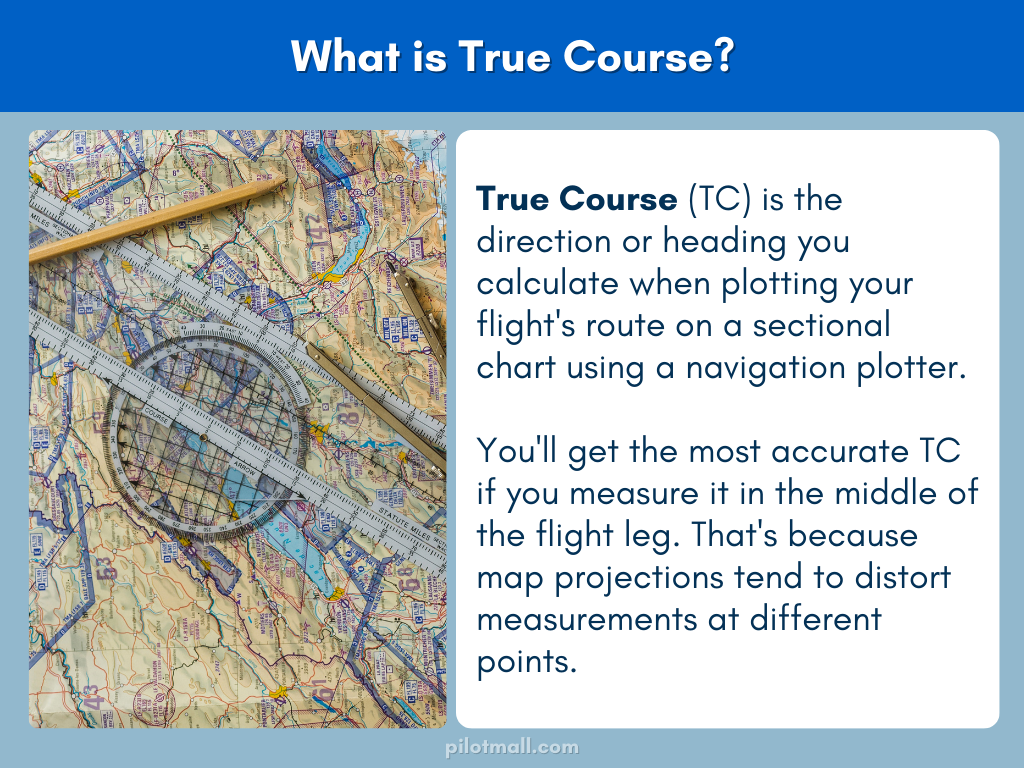
True Course (TC) is the direction of your intended ground track (the course line you draw on your sectional chart), measured relative to True North (the geographic North Pole). You’ll get the most accurate TC if you measure it near the midpoint of the leg using a navigation plotter, because chart projections can introduce small distortions across a long leg.
What is True Heading?
True Heading (TH) is the direction the nose of the aircraft is pointing relative to True North. To find True Heading, you start with True Course and correct for wind using a Wind Correction Angle (WCA). That “crab angle” keeps your aircraft’s ground track aligned with your intended course even when wind pushes you sideways.
What is Magnetic Course?
Magnetic Course (MC) is your True Course corrected for magnetic variation. It’s the same intended route line, but expressed in magnetic degrees instead of true degrees.
Formula: True Course ± Variation = Magnetic Course
Why it matters: this bridges what you draw on a chart (true) with what many cockpit instruments and ATC references use (magnetic).
What is Magnetic Heading?
Magnetic Heading (MH) is the aircraft’s heading relative to Magnetic North. You get MH by correcting True Heading for magnetic variation.
Formula: True Heading ± Variation = Magnetic Heading
What is Compass Heading?
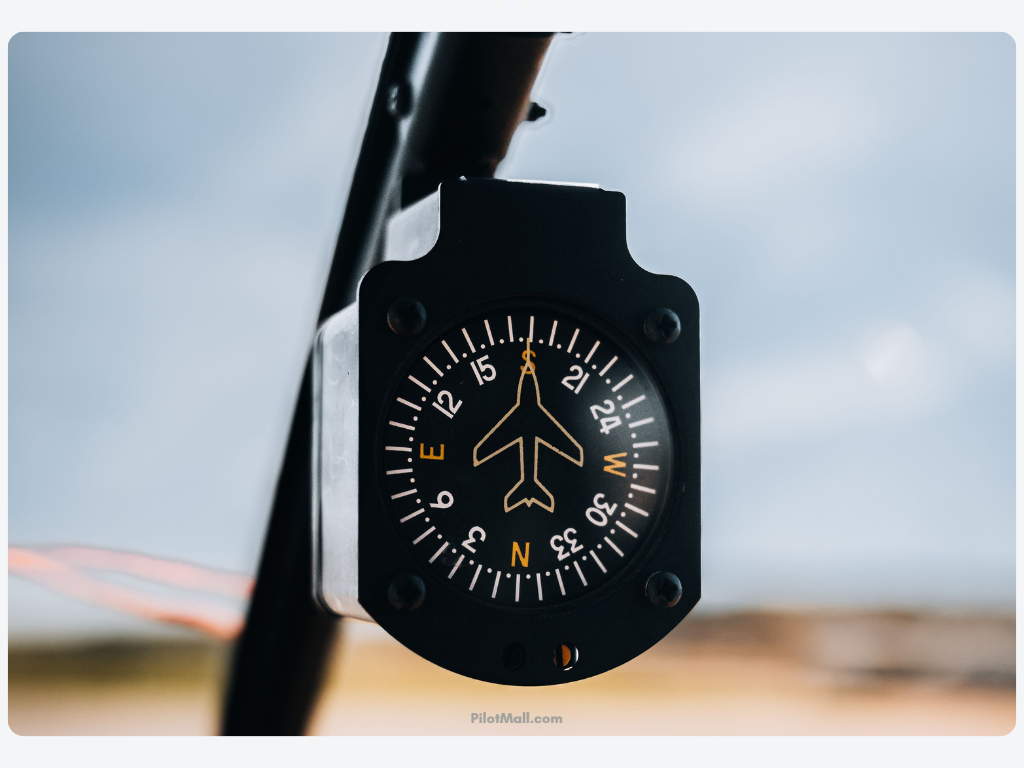
Compass Heading (CH) is what the magnetic compass actually indicates after accounting for deviation the small errors caused by the aircraft’s metal structure and onboard electrical/electronic systems. Deviation is unique to each aircraft and shown on the aircraft’s compass correction card.
Formula: Magnetic Heading ± Deviation = Compass Heading
Key Differences (Course vs Heading)
True Course vs True Heading
True Course is the path you want to follow over the ground. True Heading is where you point the nose to stay on that path when wind is present. If there is no wind, TC and TH are the same.
Magnetic Course vs Magnetic Heading
Magnetic Course is your intended ground track expressed in magnetic degrees. Magnetic Heading is where the nose points expressed in magnetic degrees. With wind, MC and MH can differ just like TC and TH can differ.
Magnetic Heading vs Compass Heading
Magnetic Heading is corrected for variation. Compass Heading is corrected for both variation and deviation (aircraft-specific compass error).
True North vs Magnetic North
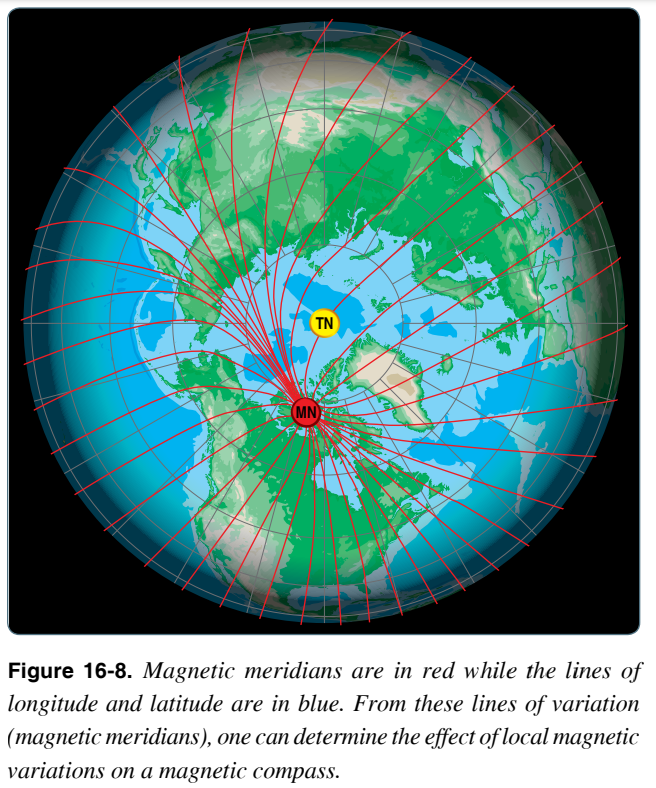
The Earth has two different “Norths.” True North is the geographic North Pole the fixed point where the Earth’s rotational axis intersects the surface. Magnetic North is where the Earth’s magnetic field points vertically downward. Because these two points are not in the same place, pilots must account for the angular difference between them: magnetic variation (also called declination).
Pro tip: Variation is location-dependent and changes slowly over time, which is why sectionals include isogonic lines and a compass rose to help you find local variation.
All Formulas at a Glance (Summary Table)
These terms make more sense when you see them as a single conversion chain:
| Step | Formula | What you’re doing |
|---|---|---|
| TC → TH | TC ± WCA = TH | Correct for wind drift (crab into the wind) |
| TC → MC | TC ± Variation = MC | Convert intended course from true to magnetic |
| TH → MH | TH ± Variation = MH | Convert heading from true to magnetic |
| MH → CH | MH ± Deviation = CH | Correct for compass error specific to the aircraft |
Mnemonic: “TV Makes Dumb Children” (True, Variation, Magnetic, Deviation, Compass)
Direction rule: West is Best, East is Least (add West variation, subtract East variation).
How to Calculate TC, TH, MC, MH, and CH
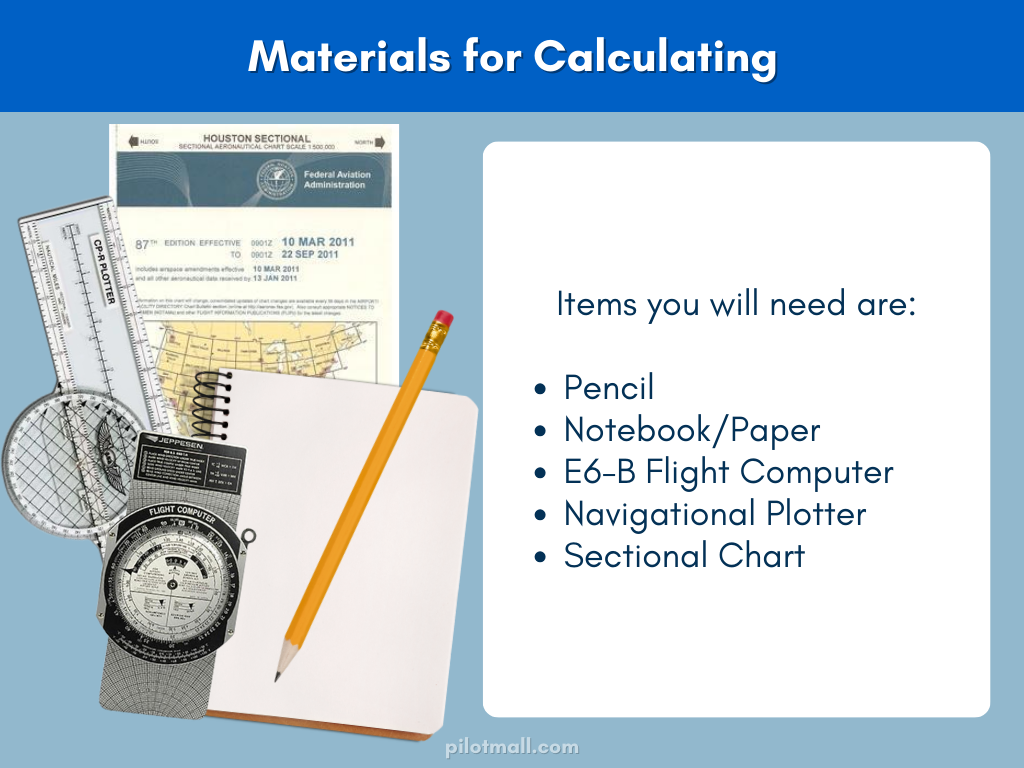
Understanding how true course, true heading, and magnetic heading work is vital for planning cross-country flights. Here are the common tools pilots use:
Materials needed:
- Pen or Pencil (pencils are ideal for training)
- E6-B Flight Computer
- Navigational Plotter
- VFR Sectional Chart
Step 1: Calculate True Course (TC)
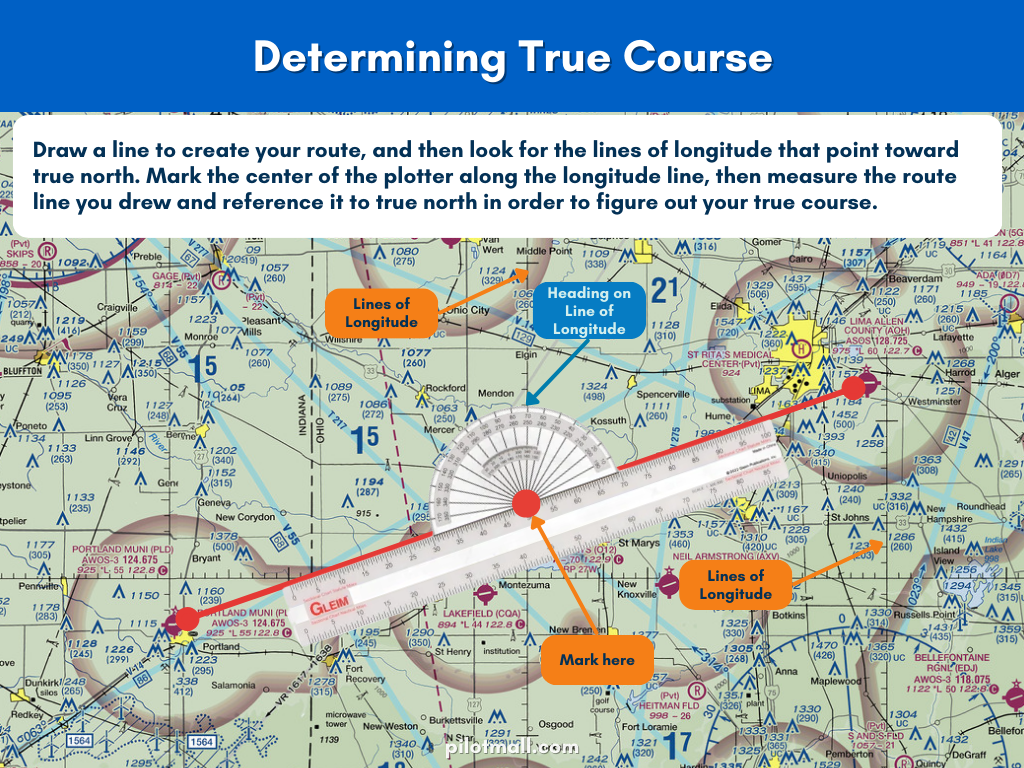
- Draw a line on your sectional chart between your departure and arrival points.
- Identify a line of longitude (vertical line) near the midpoint of your route.
- Align your plotter with your course line and the longitude line to measure the angle from True North.
- The measured value is your True Course.
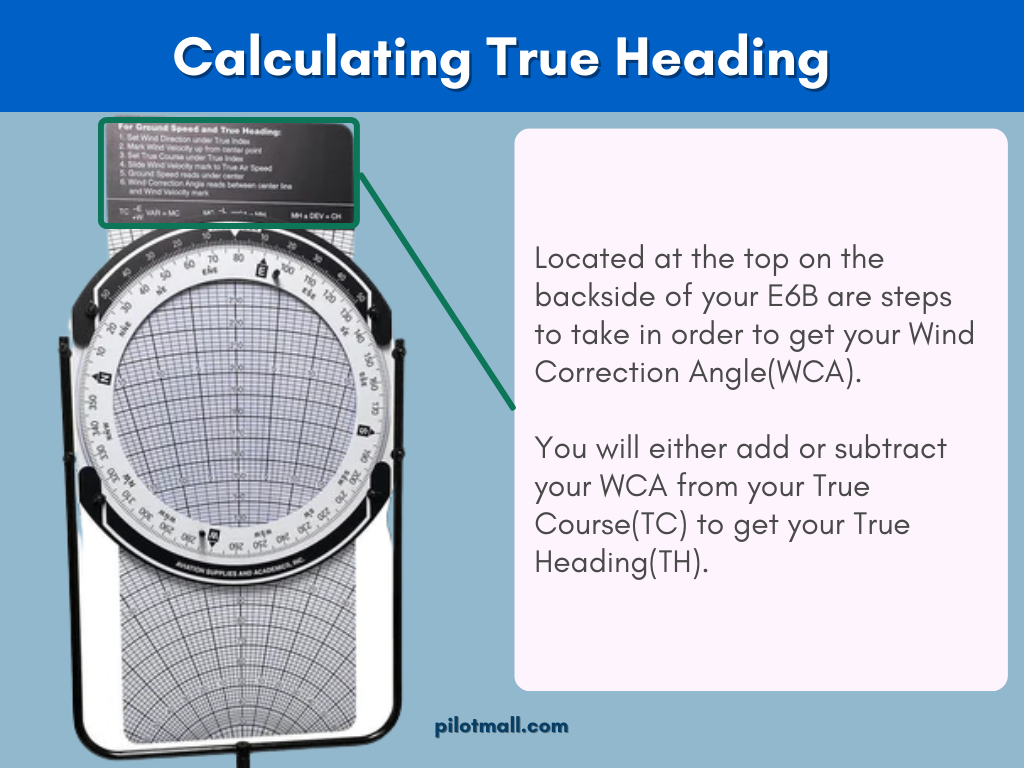
Step 2: Calculate True Heading (TH)
To find True Heading, correct your True Course for wind using an E6B flight computer. Forecast winds aloft (FD) are given relative to True North.
Example setup: True Course = 180°, wind = 215° at 20 knots
- Set wind direction under the “True Index” on your E6B and mark wind velocity.
- Rotate the wheel to your True Course (180°).
- Adjust for your True Airspeed.
- Read the Wind Correction Angle (WCA). Assume WCA is +6° (to the right).
- TC (180°) + WCA (6°) = TH (186°)
Step 3: Calculate Magnetic Course (MC)
Magnetic Course is your planned course expressed in magnetic degrees.
Formula: TC ± Variation = MC
Find variation using the sectional’s dashed magenta isogonic lines or a nearby compass rose.
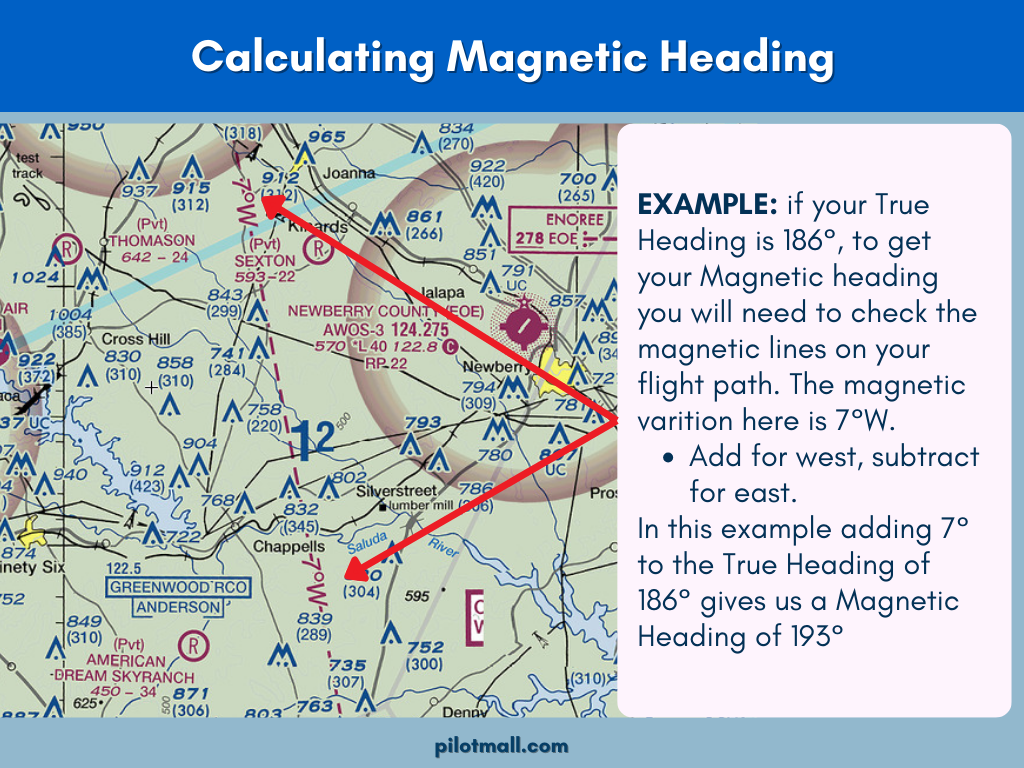
Step 4: Calculate Magnetic Heading (MH)
Now convert True Heading to Magnetic Heading using the same variation value:
Formula: TH ± Variation = MH
Direction rule: West is Best (add), East is Least (subtract).
Step 5: Calculate Compass Heading (CH)
Finally, correct for deviation using your aircraft’s compass correction card:
Formula: MH ± Deviation = CH
Wind Correction & Drift Explained (Visual Concept)
Here’s the key idea: course is where you want to go over the ground, and heading is where you point the nose to get there. When wind blows across your path, it creates drift.
- Desired: You want your ground track to match your True Course line on the chart.
- Reality: Wind pushes the airplane sideways, changing your ground track.
- Fix: Apply a Wind Correction Angle (WCA) by pointing the nose into the wind (“crabbing”).
If you’ve ever seen your GPS track line drift off the route while your heading stays steady, you’re seeing the difference between heading and track.
When GPS “Disagrees” With Your Compass
This is a common student-pilot confusion:
- GPS primarily shows TRACK (your actual path over the ground).
- Your heading indicator/compass shows HEADING (where the nose points).
In a crosswind, your heading may be, for example, 186°, while your GPS track might show 180°. Both can be correct:
- Heading includes your crab angle into the wind.
- Track reflects your actual movement over the ground.
Practical takeaway: If you’re holding the correct course, your track should match your intended course line even if your heading does not.
Complete Start-to-Finish Example (TC → CH)
Let’s run one complete example from chart to compass. This “full chain” is exactly what checkrides love:
Given:
- True Course (TC): 180°
- Wind: 215° at 20 knots
- Wind Correction Angle (WCA): +6°
- Variation: 7° West
- Deviation: 2° (example value from aircraft compass card)
Step 1 True Heading (TH):
TC 180° + WCA 6° = TH 186°
Step 2 Magnetic Heading (MH):
Variation is 7° West, so we add it (West is Best):
TH 186° + 7° = MH 193°
Step 3 Compass Heading (CH):
Apply deviation from the compass correction card. If deviation is 2° (example), apply the card’s direction (+/–):
MH 193° ± 2° = CH 191° or 195° (depending on whether deviation is East or West for that heading)
Important note: Deviation is not a single global number it changes by heading and aircraft, so always use the correction card.
Quick Knowledge Check (Quiz)
Use these to test your understanding. (Great for students and instructors.)
- Magnetic Course: If TC = 090° and variation is 10° East, what is MC?
- Magnetic Heading: If TH = 270° and variation is 5° West, what is MH?
- Wind: In a strong crosswind, which is more likely to match your planned route line: heading or track?
- Compass: Why can Compass Heading differ from Magnetic Heading in the same airplane?
Show Answers
1) East is Least → 090° − 10° = 080° MC
2) West is Best → 270° + 5° = 275° MH
3) Track (ground track) is what should match the course line when correctly corrected for wind.
4) Deviation aircraft-specific magnetic interference affects the compass.
Why This Still Matters in a GPS World
Modern GPS navigation is incredible, but pilots still train these fundamentals for a reason:
- Redundancy: If electronics fail, your compass and chart skills become your primary backup.
- Better decision-making: Understanding drift, variation, and heading/track differences prevents “automation confusion.”
- Checkride readiness: TC/TH/MC/MH/CH concepts appear in oral exams and cross-country planning.
- Variation changes over time: The magnetic field shifts slowly, which is why charts and databases get updated.
When you know how to move between true and magnetic, you can confidently plan, fly, and verify your navigation even when conditions aren’t perfect.

Frequently Asked Questions
- What is the difference between course and heading?
- Course is your intended path over the ground (what you plan). Heading is where you point the aircraft’s nose to maintain that course especially when wind is present.
- What is Magnetic Course (MC) vs Magnetic Heading (MH)?
- Magnetic Course is the intended ground track in magnetic degrees. Magnetic Heading is the direction the nose points in magnetic degrees. With wind, they may differ.
- What is track vs heading on GPS?
- Track is your actual movement over the ground (what GPS shows). Heading is where the nose points. In crosswinds, track and heading can differ significantly.
- What is magnetic variation (declination)?
- Magnetic variation is the angular difference between True North and Magnetic North at a specific location. It’s shown on sectional charts with dashed magenta isogonic lines and compass roses.
- Is variation added or subtracted?
- A common memory aid is: West is Best, East is Least. In many training problems: add west variation, subtract east variation. Always confirm the direction based on the conversion you’re doing (true ↔ magnetic).
- What is the difference between Magnetic Heading and Compass Heading?
- Magnetic Heading is referenced to magnetic north. Compass Heading is what the magnetic compass shows after accounting for deviation, which is aircraft-specific magnetic interference.
- Should ATC headings be true or magnetic?
- ATC provides headings in Magnetic Degrees in most operations. For example, “Fly heading 180” means turn until your heading indicator reads 180 magnetic.
- What is “Celestial North”?
- Wikipedia describes this as the two points in the sky where Earth’s axis of rotation, indefinitely extended, intersects the celestial sphere.
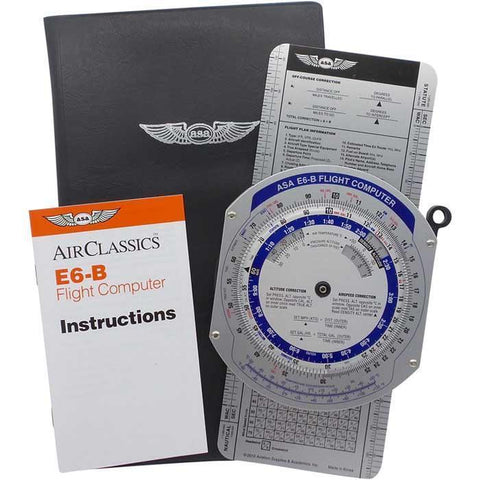 |
ASA Color E6BASA's Color E6B takes the standard "whiz wheel" manual flight computer and updates it with striking color accents. Though identical in functionality and size to its standard ASA-E6B, this version of the solid aluminum flight computer utilizes a variety of colors to signify its various functions. |

Takeaway
Understanding the relationship between True Course, True Heading, Magnetic Course, Magnetic Heading, and Compass Heading is a rite of passage for every pilot. These concepts bridge the gap between a paper chart and the real world you see through the windshield especially when wind and magnetism refuse to behave the way you wish they would.
Master the chain, practice a few examples, and you’ll quickly gain confidence planning and flying cross-country routes even if the electronics go dark.
Did you enjoy learning about True Course vs True Heading?
Check out these links to learn more about aviation educational guides.


3 comments
As a retired USAF nav, Ned is correct. This page needs to be fixed. “A true course is a heading based on the direction you intend to travel. A true heading is the course corrected for magnetic declination.” The second sentence is describing Mag Course. True heading is true course corrected for winds.
Thank you so much for this informative article. Amazing work and very helpful.
True Course (TC) is what you measure with your plotter off a sectional chart.
True Heading (TH) is your TC corrected for winds using your Whiz Wheel.
Mag Heading (MH) is your TH corrected for mag var and that is what you fly.
Reference: Air Force Manual 51-40, Air Navigation.
Navigators care about TC and TH etc. But, pilots want the MH to fly.