




Class G Airspace: Everything You Need to Know
Unlike the other five classes of airspace, Class G airspace is uncontrolled. It simply exists anywhere that is not designated as Class A, B, C, D, or E. Class G airspace will be found bordering Class E airspace which is another type of airspace that often needs a bit of explanation. While IFR traffic is controlled in Class E airspace, once you enter Class G, both VFR and IFR traffic are uncontrolled.
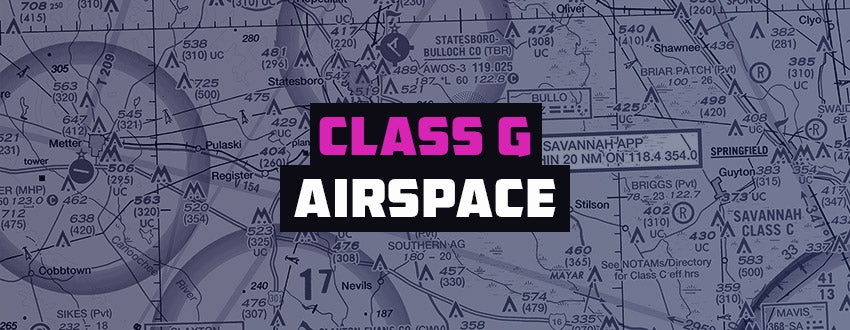


Class G airspace is uncontrolled airspace, any airspace not designated Class A, B, C, D, or E. Air traffic control provides no separation services to VFR or IFR traffic in Class G. It typically extends from the surface up to the overlying Class E floor, most often 700 or 1,200 feet AGL, though in parts of the western U.S. it can reach 14,500 feet MSL.
Last updated: June 2026
What is Class G Airspace?
Unlike the other five classes of airspace, Class G airspace is uncontrolled. It simply exists anywhere that is not designated as Class A, B, C, D, or E. Class G airspace will be found bordering Class E airspace which is another type of airspace that often needs a bit of explanation.
While IFR traffic is controlled in Class E airspace, once you enter Class G, both VFR and IFR traffic are uncontrolled.

How to Find Class G Airspace
Class G is often not specifically indicated on sectionals. The easiest way to locate Class G is by first finding Class E. Once you have located Class E airspace, any non-designated space between the surface and where Class E starts is by default, Class G.
The upper limit of Class G varies by location: it extends up to the floor of the overlying Class E airspace, most often 700 or 1,200 feet AGL, but in parts of the western U.S. it can reach as high as 14,500 feet MSL before Class E begins.
Class G is more prevalent and may be found at lower altitudes in less dense areas of the country where IFR operations are less common. Sectionals for these areas indicate Class G by placing a faded blue boundary line around it.

Restrictions in Class G Airspace
Class G airspace may be uncontrolled, but that does not mean that it is unregulated. Although restrictions are few, they do exist, and pilots must be familiar with these restrictions as well as the weather requirements for this airspace.
- No communications requirements
- No specific instrument requirements for VFR pilots below 10,000 feet MSL
- Mode-C transponder required for VFR pilots flying above 10,000 feet MSL
- IFR pilots must meet standard IFR equipment requirements
- IFR pilots must meet IFR flight level or altitude requirements along with remaining at least 1,000 feet above the highest obstacle within a horizontal distance of 4 nautical miles from your course (2,000 feet in designated mountainous terrain)
- Maximum speed of 250 kts while flying below 10,000 feet MSL

Weather Minimums in Class G Airspace
The weather minimums in Class G vary based on altitude, whether it is day or night, and proximity to an airport. Here is what to know:
- 10,000 feet MSL or higher
- 5 sm visibility
- Cloud clearance minimums of 1,000 feet above, 1,000 feet below, and 1 SM horizontally
- Above 1,200 feet AGL but below 10,000 feet MSL during the day
- 1 sm visibility
- Cloud clearance minimums of 1,000 feet above, 500 feet below, and 2,000 feet horizontally
- Above 1,200 feet AGL but below 10,000 feet MSL at night
- 3 sm visibility
- Cloud clearance minimums of 1,000 feet above, 500 feet below, and 2,000 feet horizontally
- 1,200 feet AGL and lower during the day
- 1 sm visibility
- Clear of clouds vertically and horizontally
- 1,200 feet AGL and lower at night
- 3 sm visibility
- Cloud clearance minimums of 1,000 feet above, 500 feet below, and 2,000 feet horizontally
- Below 1,200 feet AGL, at night, within ½ mile of airport, and in the traffic pattern
- 1 sm visibility
- Clear of clouds vertically and horizontally
IFR Altitudes in Class G Airspace
To assist with aircraft spacing, the FAA has established designated flight altitudes for IFR traffic in Class G. Altitude is based on your magnetic course or ground track. If your course is 0° to 179° and you are below 18,000 feet MSL, fly odd thousands MSL, (3,000; 5,000; 7,000, etc.).
For pilots flying below 18,000 feet MSL on a course of 180° to 359°, fly even thousands MSL, (2,000; 4,000; 6,000, etc.).
Communications in Class G Airspace
It may not be required, but proactive communication within Class G airspace is certainly encouraged. Announcing your position to other pilots while you are in the vicinity of a Class G airspace airport enhances everyone’s safety. Without a controller to help coordinate traffic, each pilot must do their part to helps other pilots see and avoid them.
It is recommended that you make position calls at each of the following points:
- 10 miles away from the airfield
- 5 miles away from the airfield
- While overflying the airfield (if necessary)
- 45-degree entry to the downwind
- Downwind
- Base
- Final
Takeaways
Class G airspace is the only fully noncontrolled airspace of the six classes of airspace. Pilots may fly within Class G airspace provided they operate within the restrictions and meet the weather minimums assigned by the FAA.
Although radio communications are not required within Class G airspace, when landing at an airport located within this airspace, it is recommended that pilots make position calls starting 10 miles out to help other pilots locate and avoid them.
Check out our Flight Training Material collection for hundreds of books and training material.

|
Jeppesen Private Pilot ManualIn addition to serving as the primary text in Jeppesen's arsenal of Private Pilot training materials, this fact-filled and heavily illustrated manual goes far beyond the basics to ensure students have the most thorough instructional content available in print.
|

Want a quick refresher on the other categories of airspace? Check out these articles:
- Class A Airspace: and How it Differs from All Other Categories of Airspace
- Class B Airspace: Who Can Enter and How to Get Permission
- Class C Airspace: All the Details You Need to Know
- Class D Airspace: Everything You Need to Know
- Class E Airspace: The Logic Behind It (Guide)
Frequently Asked Questions
What is Class G airspace?
Class G airspace is uncontrolled airspace, any airspace that is not designated Class A, B, C, D, or E. Air traffic control does not provide separation services to aircraft operating in Class G, and no ATC clearance or two-way radio communication is required to fly there under VFR.
How high does Class G airspace go?
Class G extends from the surface up to the floor of the overlying Class E airspace. In most of the U.S. that floor is 700 or 1,200 feet AGL, but in parts of the western U.S. Class G can reach up to 14,500 feet MSL before Class E begins.
What are the VFR weather minimums in Class G airspace?
Below 1,200 feet AGL during the day you need 1 statute mile visibility and must stay clear of clouds. At night below 1,200 feet AGL, and above 1,200 feet AGL up to 10,000 feet MSL, you need 3 statute miles visibility (1 statute mile by day above 1,200 AGL) with cloud clearance of 500 feet below, 1,000 feet above, and 2,000 feet horizontal. At or above 10,000 feet MSL you need 5 statute miles and 1,000 below, 1,000 above, 1 statute mile horizontal.
Do you need a clearance or radio to fly in Class G airspace?
No. Class G is uncontrolled, so neither VFR nor IFR aircraft need an ATC clearance to operate there, and there are no two-way radio communication requirements. Pilots are still responsible for see-and-avoid and for meeting the applicable VFR weather minimums.
Is a transponder required in Class G airspace?
A transponder is generally not required in Class G airspace, since transponder rules apply to Class A, B, and C airspace and to flight at or above 10,000 feet MSL (excluding airspace below 2,500 feet AGL). If you climb at or above 10,000 feet MSL over the contiguous U.S., a Mode C transponder is required.
How do you find Class G airspace on a sectional chart?
Class G is the airspace left over where no other class is charted. On a VFR sectional, the faded blue and magenta vignettes mark where the overlying Class E floor drops to 1,200 or 700 feet AGL; below those floors, and outside any other charted airspace, the airspace is Class G.
What is the difference between Class G and Class E airspace?
Class E is controlled airspace where ATC provides separation to IFR traffic, while Class G is uncontrolled and ATC provides no separation. In most areas Class G lies beneath Class E, so the Class E floor (700 or 1,200 feet AGL in many places) marks the top of Class G.
About the author: Neil Glazer is a Commercial Pilot (Multi-Engine and Instrument) and the founder of PilotMall.com, where he has helped thousands of pilots, from first-lesson students to airline captains, choose the right gear for every stage of flying.


1 comment
Looks like there might be a typo here. In Class G above 10,000 MSL, the vis requirement is 1,000’ above, 1,000’ below, and 1SM horizontally (not 2,000’).