




Sport Pilot License: Step-by-Step Guide to Becoming a Sport Pilot
The sport pilot license, or certificate, is the FAA’s newest addition to the pilot certificate line-up. Developed in 2007, the purpose of the sport pilot certificate is to make flying more affordable and easily available to everyone. Now students who aren’t yet able to afford the time investment or cost of a private pilot license have a quick and inexpensive alternative.


Last updated June 2026
What is a sport pilot license?
Learning to fly is one of the most rewarding experiences you can have. The sport pilot license, or certificate, is an FAA pilot certificate created in 2004 to make flying more affordable and accessible. It was significantly expanded by the FAA's MOSAIC rule (Modernization of Special Airworthiness Certification), whose new sport pilot privileges took effect on October 22, 2025.
What changed under MOSAIC: sport pilots are no longer limited to small, two-seat, weight-restricted light-sport aircraft. You can now fly a much wider range of aircraft (any with a clean stall speed of 59 knots CAS or less and up to four seats), and you can fly at night with the proper training, a CFI endorsement, and a third-class medical or BasicMed. You may still carry only one passenger.
A student pilot who isn’t yet able to afford the time investment or cost of a private pilot license has a quick and inexpensive alternative.
Intrigued? Read on to discover if a sport pilot license may be right for you.

Who is eligible for a sport pilot license?
In order to qualify for a sport pilot certificate, you must:
- Be at least 16 years old when you start training
- Be at least 17 years old when you take your test
- Be able to read, write, speak and understand English
- Have a valid U.S. driver’s license (unless you will only be flying gliders or balloons)
- Obtain a student pilot certificate
- Log a designated number of hours of flight and training time
- Pass a written and practical test

What kind of planes can I fly with a sport pilot license?
Under MOSAIC, the aircraft a sport pilot may fly are no longer defined by the old weight-based "light-sport aircraft" category. Instead, a sport pilot may operate an aircraft that meets these limits:
- Max clean stall speed (VS1): 59 knots CAS or less (up from the old 45-knot limit)
- Max number of seats: 4 (a sport pilot may still carry only 1 passenger)
- Engines: single-engine
- Propeller and landing gear: fixed, or controllable-pitch propellers and retractable gear with additional training and a CFI endorsement
- Cabin: unpressurized
MOSAIC removed the old 1,320 lb weight cap and the strict two-seat limit, so a much wider range of certificated and experimental aircraft now qualify. The companion airworthiness provisions that let manufacturers certify these larger light-sport aircraft phase in on July 24, 2026.
Light sport aircraft come in multiple categories including:
- Fixed-wing airplane
- Glider
- Lighter-than-air (i.e. airship or balloon)
- Rotorcraft (gyroplane)
- Powered parachute
- Weight-Shift control aircraft (i.e. trikes)
Want an even better idea of which specific aircraft you can fly with your sport pilot certificate? Check out the AOPA’s list of currently certified light sport aircraft.

What flight restrictions does a sport pilot license come with?
As an entry-level pilot license, and one that is fast to earn, the FAA places certain safety parameters on the types of flights you are eligible to fly.
- You cannot carry passengers or property for hire or compensation. (MOSAIC does newly permit limited aerial work for compensation, such as aerial photography, surveying, and pipeline or infrastructure patrol, but only with additional training, a per-operation instructor endorsement, and no passenger aboard.)
- Limited to 1 passenger, even in an aircraft with up to 4 seats
- Night flight is allowed with the required training, a CFI endorsement, and a third-class medical or BasicMed (it was prohibited entirely before MOSAIC)
- You must have at least 3 miles of visibility
- No flying in Class B, C, or D (towered) airspace unless you have received additional flight instruction and an instructor endorsement
- No flying outside the United States
- Maximum altitude of 10,000 feet MSL, or 2,000 feet AGL where the terrain makes that higher

What is the difference between a sport pilot license and a recreational pilot license?
As the two entry-level pilot certificate options, there are a lot of similarities between a sport pilot license and a recreational pilot license.
Both are less expensive and take fewer hours to earn than a standard private pilot license. In both cases, pilots are limited to one passenger and cannot fly in towered air space without additional flight instruction.
The main differences between the sport pilot and recreational pilot are:
Sport Pilot
- FAA medical certificate: Not required for day flight (driver's license or BasicMed); night flight requires a third-class medical or BasicMed
- Aircraft size: Any aircraft with a clean stall speed of 59 knots CAS or less and up to 4 seats (1 passenger limit)
- Minimum flight training time: 20 hours
- Night flight: Allowed with training, a CFI endorsement, and a third-class medical or BasicMed
Recreational Pilot
- FAA medical certificate: Class 3 certificate required
- Aircraft size: Limited to 180 hp max and 4 seats
- Minimum flight training time: 30 hours
- Night flight: Add-on certification/rating can be earned. No passengers allowed.
As you can see, for a student pilot, the advantages of the sport pilot license are you most likely will not need to get and renew a medical certificate, plus it takes 10 fewer hours of training to meet the requirements. This saves not only time but also money.
The tradeoff is that with a sport pilot certificate you are limited to one passenger and a narrower performance envelope than a private certificate. Under MOSAIC you can now add night flying with extra training, an endorsement, and a medical or BasicMed, so this route fits well if you want a faster, lower-cost path and do not need to carry more than one passenger.

What is the difference between a sport pilot license and a private pilot license?
A private pilot license is the most common initial certification that student pilots opt for. How does it compare to the sport pilot certification? Let’s have a look.
Sport Pilot
- FAA medical certificate: Not required for day flight (driver's license or BasicMed); night flight requires a third-class medical or BasicMed
- Aircraft size: Any aircraft with a clean stall speed of 59 knots CAS or less and up to 4 seats
- Minimum flight training time: 20 hours
- Night flight: Allowed with training, a CFI endorsement, and a third-class medical or BasicMed
- Maximum number of passengers: 1
- Flights in Class B, C or D airspace: Additional flight instruction and endorsement required
- Flight outside the United States: Not allowed
- Flights with less than 3 miles visibility: Not allowed
Private Pilot
- FAA medical certificate: Class 3 certificate required
- Aircraft size: Unlimited (may need type ratings for certain aircraft)
- Minimum flight training time: 40 hours
- Night flight: Allowed
- Maximum number of passengers: No limit
- Flight outside the United States: Allowed
- Flights in Class B, C or D airspace: Allowed
- Flights with less than 3 miles visibility: Allowed in uncontrolled airspace
What does this mean for you? If you don't plan to fly outside the United States, carry more than 1 passenger, or fly in visibility under 3 miles, a sport pilot certificate may be the faster, easier, and less expensive option. Under MOSAIC it now covers a much wider range of aircraft, and night flying is available as an add-on with training and a medical or BasicMed.
How much does a sport pilot license cost?
Learning to fly should be accessible to everyone, and as we just mentioned, one of the selling points for a sport pilot license is the lower cost. In comparison to the average $6,000 - $7,000 for a recreational pilot license, and even more for a private pilot license, the average sport pilot license can be earned for $4,400 - $5,500. That’s at least a $1,500 - $1,600 savings. When shopping around for a flight school, ask them if they offer training for a sport pilot license.

How do I get a sport pilot license?
1. Be sure you meet the requirements
Before you get started on the process, check the certification requirements and make sure that you qualify. As a reminder, you must be at least 16 years old to start training and 17 years old to take the test.
You must be able to read, write, speak and understand the English language. You must also have a valid U.S. driver’s license (unless you will only be flying gliders or balloons).
2. Apply for a student pilot certificate
As with all other pilot’s certificates, before you can start your sport pilot flight training, you must first apply for and receive a student pilot certificate. The fastest way to do this is to fill out an online application on the Integrated Airman Certification and Rating (IACRA) website, but you can also print and fill out FAA form 8710-1.
The next step is to submit your printed 8710-1 or proof of digital filing to an approved party. You have plenty of choices here including a Flight Standards District Office (FSDO), a certified flight instructor (CFI), an FAA-designated pilot examiner (DPE), or a part 141 flight school’s airman certification representative.
Whomever you submit your application to will process it and forward it to the Airmen Certification Branch for review. You should get your printed certificate in the mail in the next 3 weeks.
3. Get your 3rd class medical certificate (if necessary)
Every other level of pilot certification requires you to go through a medical certification process and then renew that certification on a regular basis. The good news is that most sport pilots are exempt from this.
You instead go by the restrictions on your U.S. driver’s license (i.e. if you need corrective lenses for driving, you are expected to wear them for flying as well) and you self-certify that you meet the requirements for being a safe pilot.
Now, we said “most” sport pilots are exempt because in a few cases, you will still need to see an Aviation Medical Examiner (AME) for a medical exam and certification.
If any of the following circumstances apply to you, you will need to obtain a medical certificate:
- You have previously applied for a medical certificate and your most recent application was denied
- You have previously held a medical certificate and your most recently issued medical certificate was suspended or revoked
- You have a known medical condition which may negatively impact your ability to safely operate a light-sport aircraft
If you need to get a medical certificate, log into MedXPress to begin the application process. Next, locate an Aviation Medical Examiner (AME) and book an appointment.
The AME will review your application, ask you some questions and conduct a medical examination to determine whether you are medically qualified to fly. Assuming you are, the AME will then issue you a medical certificate.

4. Complete ground training
For your training, you can choose a specific certified flight instructor (CFI) or sign up with a pilot school. Your instructor or school will provide you with ground training on operational, aeronautical, meteorological, and procedural topics. Ground school prepares you to take your written exam and gives you the baseline knowledge you will need before you get in the air.
5. Take and pass your FAA written exam
This may be the entry-level pilot certificate, but that doesn’t mean that you don’t have to prove your knowledge. Would-be sport pilots must study for and pass a written test that demonstrates their academic understanding of important principles, concepts, procedures and regulations.

6. Flight training
Now that you’ve passed your written test, you’re ready to apply what you’ve learned and gain real-world skills.
You will need to attend a flight school or receive flight training and log a minimum of 20 hours of flight time before you are eligible to take your check ride, although the average student takes closer to 33 hours before their CFI is ready to sign them off for the test. Fifteen of these hours must be with an instructor and you must have at least five hours of solo flight time before testing.
7. Check ride
Once your meet your training minimums and your CFI feels you are ready, he or she will sign off on your skills and help you schedule your check ride with a designated pilot examiner (DPE).
The DPE will administer a verbal and practical exam, often referred to as a check ride. Make sure to have your medical, all required documentation, and your driver's license. This is your day to prove you have mastered the skills and gained the knowledge needed to be a safe sport pilot.
Prove your competency to the examiner and once the test is over, they will help you to submit your final paperwork to the FAA so you are officially a licensed sport pilot.
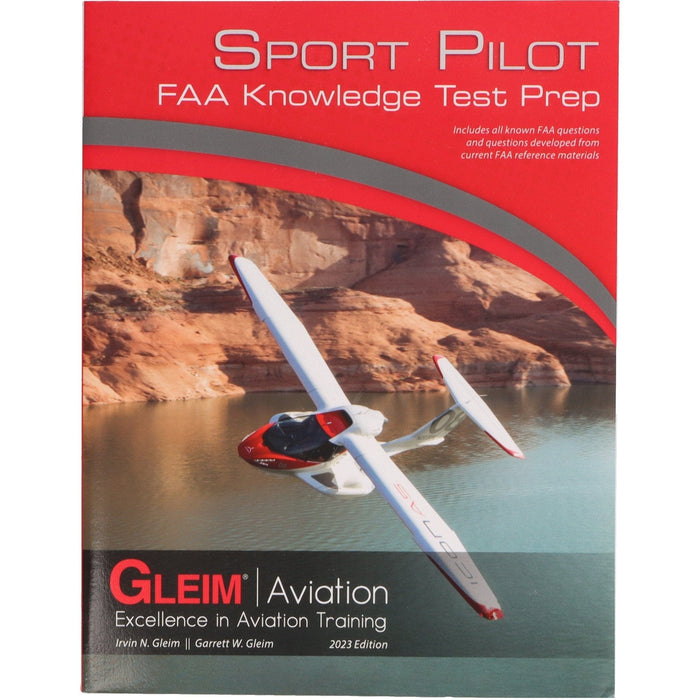
Pick up a copy of Gleim 2023 Sport Pilot FAA Knowledge Test to start preparing for your written exam today.
|
Gleim 2023 Sport Pilot FAA Knowledge TestWith its Sport Pilot FAA Knowledge Test book, Gleim continues its popular series of training tools designed to help users ace the FAA written exam. To facilitate its focus on the Sport Pilot knowledge test, all extraneous material is excluded from this book. In its place, users will find every question currently contained in the FAA's test question data bank.
|


4 comments
I have a sports pilot license but haven’t flown for several years. Am I required to take a check ride with a DPE before carrying a passenger?
LSA rules are changing! This is from AOPA:
MOSAIC ditches the current LSA weight limit of 600 kilograms (1,320 pounds) and replaces it with “performance-based” measures such as a 54-knot maximum clean stall speed (Vs1) that will allow airplanes with gross weights up to about 3,000 pounds to be operated by sport pilots.Jul 25, 2023
I have a private pilot’s license but I don’t believe that I could get a medical it has been a good while since I have flown. What do I have to do to be able to fly a light sport air craft.
I have a private fixed wing and commercial rotorcraft license. I don’t think I can qualify for a 3rd class medical. Can I apply for a sport pilot’s license and forgo the flight training?