




At What Altitude Should Pilots Use Oxygen? (It’s Lower Than You Think)
What kind of pilot would fly after a drink? Not you, right? Good. Same here, but if we are being honest, how many of us have experienced signs of hypoxia (oxygen deficiency) while at the controls?


What kind of pilot would fly after a drink? Not you, right? Good. Same here, but if we are being honest, how many of us have experienced signs of hypoxia (oxygen deficiency) while at the controls?
Hypoxic flying is impaired flying even if we aren’t at an altitude where supplemental oxygen is legally required. Even a symptom as mild as decreased night vision means we are piloting while not at our best.
When flying an unpressurized plane, a good oxygen system setup should be part of our standard equipment whether our flight plan takes us to higher altitudes or not. Despite what we used to believe, oxygen is not just for fighter pilots or lightweights. It’s something we all need to plan for.
If supplemental oxygen has been on your back burner list or you just want to learn more about staying properly oxygenated in the cockpit, stick around. We will share why you may want to consider using oxygen at a lower altitude than you thought, plus how to tell for sure when you personally need oxygen.
Key Takeaways
- 14 CFR 91.211 requires flight crew to use supplemental oxygen after 30 minutes above a cabin pressure altitude of 12,500 feet, at all times above 14,000 feet, and requires oxygen to be provided to every occupant above 15,000 feet.
- Legal does not mean safe: the FAA recommends oxygen above 10,000 feet during the day and above 6,000 feet at night, because hypoxia symptoms can start between 7,000 and 10,000 feet.
- A pulse oximeter is the only way to know your real status. Any in-flight SpO2 reading below 90 percent means you need oxygen, no matter the altitude.
- Equipment follows altitude: nasal cannulas are approved up to 18,000 feet, masks are required above that, and pressurized aircraft carry their own rules under 91.211(b).
- Night vision is the first casualty of hypoxia and measurably degrades as low as 5,000 feet.
FAA Supplemental Oxygen Requirements
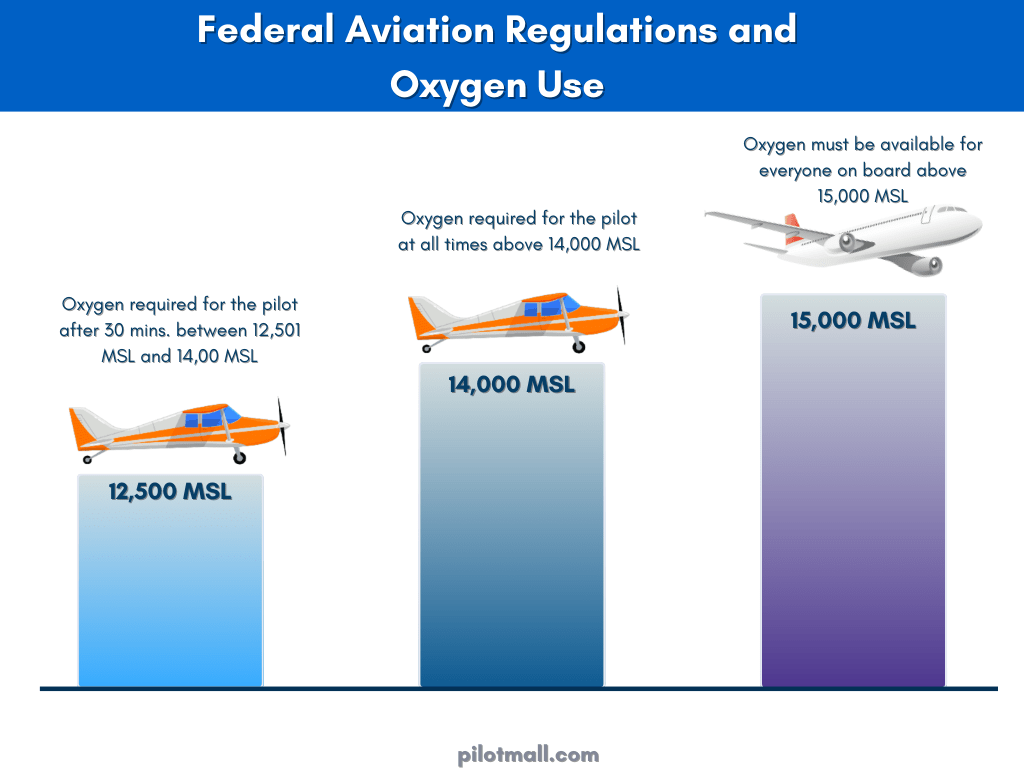
Let’s start with the regulations. The oxygen rules for unpressurized flight live in 14 CFR 91.211, and they are written around cabin pressure altitude, not what your altimeter reads. They break down into three tiers:
- 12,500 up to 14,000 feet: the required flight crew must use supplemental oxygen for any portion of flight at these altitudes lasting longer than 30 minutes.
- Above 14,000 feet: the required flight crew must use supplemental oxygen the entire time.
- Above 15,000 feet: every occupant of the aircraft must be provided with supplemental oxygen.
So the short legal answer is that supplemental oxygen for pilots is always required at cabin pressure altitudes of 14,000 feet and higher, the 30-minute clock starts at 12,500 feet, and your passengers must have oxygen available above 15,000 feet. Memorize the tiers, but do not stop reading here, because the regulatory floor is well above the physiological one.
What Causes Hypoxia?

Our bodies, and especially our brains, need the oxygen molecules in the air to pass into our bloodstream and be delivered to our tissues in high enough concentrations to support proper function. As we fly to higher altitudes, atmospheric pressure is decreased, and the air becomes less dense.
Although the air still contains twenty-one percent oxygen molecules, with the decreased “partial pressure,” when we breathe those molecules in, fewer are pushed through the alveoli of our lungs and into our bloodstreams. We either need to breathe in an increased percentage of oxygen or we need extra pressure to help force the existing oxygen into our blood. Hypoxia occurs when our body tissues aren’t receiving enough oxygen.
Symptoms of Hypoxia
Symptoms of hypoxia in pilots start out subtle. They intensify over time and with increased altitude. The initial symptoms vary from person to person and can include:
- Decreased night vision
- Blurred vision
- Black and white vision
- Tunnel vision
- Mild euphoria
- Increased breathing rate
- Rapid heartbeat
- Sweating
- Tingly skin, lips, fingers, and/or toes
- Dull headache
- Fatigue
- Confusion
- Decreased reaction time
Because we each respond differently to hypoxia, it’s hard to recognize those initial subtle signs and symptoms if we aren’t looking for them. The mild euphoria and mental confusion that often come with hypoxia can cloud our judgment and keep us from realizing there is even a problem. This is where a pulse oximeter comes in handy since it provides quantifiable and actionable health data.
The FAA’s hands-on hypoxia training courses provide another fantastic awareness-building opportunity. These courses put pilots in a controlled altitude simulator where they can observe and note their personal responses to hypoxia. This knowledge makes it easier to recognize the onset of hypoxia in ourselves.
How Do You Know When You Need Supplemental Oxygen?
Is following the FAA oxygen rules enough to stay safe? Not necessarily. The only way to know your oxygenation status for sure is to check your levels using a pulse oximeter, also known as an SpO2 meter.
When we breathe, the oxygen taken in by our lungs is transferred into our bloodstream and travels throughout our bodies so all our tissues receive oxygen. The amount of oxygen bonded to our red blood cells and circulating in our blood is referred to as our oxygen saturation (SpO2) level.
SpO2 levels are measured as a percentage with “normal” levels being 95% or higher. If we check our SpO2 levels during flight and see saturations lower than 90%, that means our body needs extra oxygen no matter what altitude we are currently at. Medical conditions, smoking, a sedentary lifestyle, and living at sea level can all cause our oxygen saturation to drop off even faster and at lower altitudes.
A simple SpO2 device can be purchased online, in pharmacies, and at big box retailers. The most common style of pulse oximeter is one that you slide your finger into, but easy-to-wear wristwatch style models are also available. Take a baseline reading on the ground before you launch, then recheck every 15 to 30 minutes at cruise.

Pro Tip: If you use a fingertip design, know that both cold fingers and dark nail polish can produce artificially low oxygen readings. Warm up your hands and try to avoid wearing dark polish to get the most accurate readings.
At What Altitude Do I Need Supplemental Oxygen?

So, what’s the bottom line? At what altitude do we need extra oxygen? You are probably familiar with the saying “legal doesn’t mean safe.” That certainly applies here. Just because the FAA doesn’t require pilots to use supplemental oxygen below 12,500 feet, it doesn’t automatically mean it’s safe to leave our oxygen masks or cannulas stowed.
Although the 12,500-foot rule is still in place, the FAA recognizes that a pilot’s blood oxygen saturation (SpO2) levels can drop below the 90% threshold and initial hypoxia symptoms can appear between 7,000 and 10,000 feet, well below the 12,500 feet legal level.
For these reasons, to improve pilot safety, the FAA now recommends that pilots use supplemental oxygen when flying above 6,000 feet at night and above 10,000 feet during the day.
Note: Decreased night vision is one of the first symptoms of hypoxia since our eyes require increased levels of oxygen at night. This symptom has been documented at altitudes as low as 5,000 feet. On average, women experience the effects of hypoxia and need supplemental oxygen 2,000 feet lower than men do.
Cannula, Mask, or Built-In: Which Oxygen Equipment Do You Need?
Once you know the altitudes, the next question is what to breathe through. The answer is dictated partly by regulation and partly by how high and how often you fly.
Below 18,000 feet: nasal cannulas
Nasal cannulas are approved for use up to 18,000 feet, and inside that envelope they are what most GA pilots reach for. They are comfortable for hours, they do not interfere with your headset boom mic, and oxygen-conserving designs meter flow so a small cylinder lasts noticeably longer than it would on standard constant flow.
18,000 feet and above: oxygen masks
Above 18,000 feet, certification rules require a mask. Constant-flow masks handle the typical portable-system flight levels, while diluter-demand and pressure-demand masks take over in the higher flight levels where turbocharged and turbine aircraft live. If your plans include the oxygen altitudes above the cannula limit, buy a system that ships with both cannulas and masks so one kit covers every leg.
Portable vs built-in systems
For normally aspirated singles that only occasionally cross 10,000 feet, a portable system, meaning a cylinder, regulator, flowmeter, and cannulas or masks for each occupant, is the cost-effective answer, and a seat-back or strap mount keeps the bottle secured instead of loose in the cabin. Turbocharged and pressurized aircraft that routinely work the teens and above are candidates for built-in oxygen with overhead outlets at each seat. Whichever route you take, add a small rapid-response canister to the seat pocket as a backup for the day you recognize symptoms and want oxygen flowing while you start downhill.
Gear Up: Oxygen Essentials for Your Cockpit
The education above is the hard part. The equipment is easy, and all of it is in stock at Pilot Mall.

Boost Oxygen Rapid Response 12-Liter Canister
The seat-pocket backup that buys you a clear head on the way down.
- 98% pure supplemental oxygen in a featherweight 12-liter canister
- No prescription, no regulator setup, just open the cap and breathe
- Sized for a seat pocket, flight bag, or survival kit
Perfect for: every unpressurized cockpit as an emergency backup, and a smart add for night flights and mountain checkouts.
Click for Price →
Aerox Seat Back Aviation Oxygen Cylinder Holder
Keeps your cylinder secured and reachable instead of rolling around the cabin.
- Mounts to the seat back, fits all standard cylinder sizes from A through M
- Puts the valve and flowmeter where you can see and reach them in flight
- Padded carry handle doubles as ground transport, and the mount survives turbulence without complaint
Perfect for: portable-system owners who are tired of the bottle living loose on the back seat.
Click for Price →
ASA 2026 FAR/AIM Handbook
Read 91.211 in the original, with every 2026 update included.
- Complete FAR and AIM text in ASA’s proven 6 x 9 format
- Free email update service when regulations change mid-cycle
- The reference your CFI and your DPE are both quoting from
Perfect for: pilots who want the oxygen, equipment, and airspace rules straight from the source.
Click for Price →
ASA Pilot’s Handbook of Aeronautical Knowledge (8083-25C)
The aeromedical factors chapter is the deep dive this article only summarizes.
- Official FAA handbook covering hypoxia types, symptoms, and countermeasures
- Full-color charts and figures, checkride-standard explanations
- Foundational reading for every certificate and rating
Perfect for: students and rusty pilots who want the full aeromedical picture behind the oxygen rules.
Click for Price →Frequently Asked Questions
- At what altitude is supplemental oxygen required by the FAA?
- Under 14 CFR 91.211, required flight crew must use supplemental oxygen for any portion of flight longer than 30 minutes between cabin pressure altitudes of 12,500 and 14,000 feet MSL, and at all times above 14,000 feet. Above 15,000 feet, every occupant on board must be provided with supplemental oxygen. Note that the rule is written around cabin pressure altitude, not indicated altitude, which is why pressurized aircraft can cruise far higher with everyone breathing normally.
- At what altitude does the FAA recommend pilots use oxygen?
- The FAA recommends supplemental oxygen above 10,000 feet during the day and above 6,000 feet at night, even though neither is legally required. Research shows blood oxygen saturation can fall below 90 percent and early hypoxia symptoms can appear between 7,000 and 10,000 feet. Night vision degrades first, which is why the night threshold sits so much lower. Treat the legal altitudes as a ceiling, not a target.
- What SpO2 reading means I need supplemental oxygen?
- Any in-flight SpO2 reading below 90 percent means you need supplemental oxygen, regardless of your altitude. Healthy saturation at sea level is 95 percent or higher. Take a baseline reading on the ground, then recheck every 15 to 30 minutes at cruise. Remember that cold fingers and dark nail polish can produce artificially low readings on fingertip units, so warm your hands before you trust a surprising number.
- Can I use a nasal cannula at any altitude?
- No. Nasal cannulas are only approved for use up to 18,000 feet; above that you must switch to an oxygen mask. Within their approved range, cannulas are what most pilots prefer because they stay comfortable for hours and leave your headset boom mic unobstructed. Oxygen-conserving cannula designs can also stretch a small cylinder noticeably further than standard constant-flow setups.
- Why is supplemental oxygen recommended at lower altitudes at night?
- Because your eyes are the most oxygen-hungry sensors you carry. The rod cells that handle low-light vision demand extra oxygen, and measurable night vision loss has been documented at altitudes as low as 5,000 feet. That is why the FAA recommendation drops from 10,000 feet during the day to 6,000 feet at night. If your night cross-countries cross high terrain, supplemental oxygen belongs on your packing list.
- Is a recreational oxygen canister a substitute for an aviation oxygen system?
- No. A canister such as the Boost Oxygen Rapid Response 12-liter is a backup and recovery tool, not a primary system. It has no regulator or continuous-flow delivery, so it cannot sustain you through a long cruise segment at altitude. Where it earns its keep is the seat pocket: immediate breaths of 98 percent oxygen while you recognize symptoms and start a descent. For planned flights above 10,000 feet, carry a proper portable system with a cylinder, regulator, and cannulas or masks for each occupant.
- Does hypoxia affect every pilot at the same altitude?
- No. The altitude where hypoxia begins varies widely from pilot to pilot and even day to day. Smoking, fatigue, illness, a sedentary lifestyle, and living at sea level all lower your personal threshold, and on average women experience hypoxic effects about 2,000 feet lower than men. That variability is exactly why a pulse oximeter beats guesswork, and why the FAA's hands-on physiology training courses are worth the day they take.
- Do oxygen rules change for pressurized aircraft?
- Yes. 14 CFR 91.211(b) adds requirements for pressurized aircraft because a decompression at the flight levels leaves you seconds, not minutes, of useful consciousness. Above FL250 you must carry at least a 10-minute supplemental oxygen supply for every occupant in case of an emergency descent. Above FL350, one pilot at the controls must wear and use an oxygen mask, unless the aircraft is at or below FL410, has quick-donning masks, and two pilots remain at the controls.
About the Author
Neil S. Glazer is a commercial pilot with multi-engine and instrument ratings and the founder of PilotMall.com. He has spent more than two decades helping pilots find the right gear, from first headsets to full panel upgrades, and still answers customer questions personally.



3 comments
I live in a mountain environment and cannot stress enough that most of the FAA regs regarding oxygen are assuming the pilot is physically fit, no anomalies on the Med Cert, and no “hidden” age related issues. Every pilot worth his or her salt knows that problems can arise out of nowhere, and very very quickly can spiral out of control.
We all love to fly higher up to avoid those nasty bumps and weather anomalies, but flying in high altitude is just like driving a 4×4 into hard terrain with no spare tire. I carry an Aerox EMT-3 system, it was on sale for $300 dollars. It and a decent SpO2 pulse oximeter are WELL worth the investment. Keep your bottle inspection current, and have peace of mind knowing if you have to take a slightly higher altitude detour you can. Too many pilots (even very experienced ones) are no longer with us due to well intentioned, but poor planning in high altitude flight.
As a thirty year USAF pilot, I have been through the altitude chamber experience many times. I have to say that if I were experiencing actual hypoxia,
it’s so insidious that I don’t think I would recognize the symptoms very soon. Very scary.
I carry supplemental oxygen at all times, and although I live at a higher elevation (3 miles from KFNL at 5000’), as I’ve aged, I have found it necessary to use the O2 at any elevation above 10,000’. I have a good pulse oximeter—not a $15 el cheapo—and it confirms that my O2 percentage will drop below 90% not much higher than 10,000’ without supplemental oxygen. The FAA oxygen rules are sorely out of date and unrealistic for most of us, no matter what our physical condition and age may be.