When you park on an unfamiliar ramp, will your aircraft still be where you left it after the wind picks up? Securing a light aircraft against gusts is basic ownership discipline, and the right anchoring choice depends on where you fly and what is already on the ground.
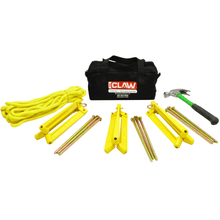
Screw-in or auger-style stakes work well when you return to the same surface, but they fight you in hard-packed ground and add up over multiple tie-down points. The Claw aircraft tie down anchors take a portable kit approach instead: three anchors, nine rust-proof spikes, 30 feet of rope, a hammer, and a carry bag that sets up in under two minutes, with no fixed ramp rings required.
Here is how pilots usually decide:
-
Backcountry, grass, and unimproved strips: choose a self-contained anchor kit. The Claw drives into grass and dirt where ramp rings do not exist, with 1,200 lbs of holding power per anchor.
-
Flying away and overnighting elsewhere: portability wins. A kit that packs into a carry bag beats anything you cannot bring with you.
-
Anchor points: a three-point setup covers both wings and the tail of most single-engine GA aircraft; twins may want a second kit.
-
Storm and high-wind protection: aluminum construction and a lifetime warranty are built for repeated all-weather use, not one-time staking.
Tie-downs are one layer of ramp protection. Keep the airframe clean with our aircraft cleaning and polishing supplies, and round out ownership gear in aircraft supplies and pilot supplies. For the cockpit, see cockpit supplies, kneeboards, and logbooks, or browse flight bags. Shopping for the owner who has everything? Try pilot gifts and aviation home decor.




 SaleVendor:The Claw